I am pretty excited about this! Hopefully the series will maintain the tone of the trailer, which many have pointed out is more X-Files than Dr. Who. In my
Showing posts with label Science Fiction. Show all posts
Showing posts with label Science Fiction. Show all posts
Friday, February 06, 2009
Torchwood: Children of Earth Trailer
I am pretty excited about this! Hopefully the series will maintain the tone of the trailer, which many have pointed out is more X-Files than Dr. Who. In my


Monday, December 22, 2008
Star Trek: Phase 2 Update - 12-22-08
The Phase 2 team has finally released the first part of "Blood and Fire" to the general public. I had the opportunity to see a rough cut of this episode when I was on set this summer and as much as I enjoyed the episode then, I REALLY enjoyed watching the final cut after I downloaded it last night.
- You can access the official download page here. This has several download options available.
- Here is Anthony Pascale's review on TrekMovie.com. The review is spoileriffic and this continues in the comments.
This episode has generated quite a bit on controversy in fandom due to the inclusion of gay crewmen and I have to say that while I did find the scene between Peter and Alex a little too long, I know it pays off in part two of the episode. And the bloodworms? Ewwwww.
In other Phase 2 news, they released an official DVD ISO for their third episode, "World Enough and Time" which features the return of George Takei to the role of Hikaru Sulu. Written by Michael Reaves and Marc Scott Zicree, the script was nominated for the SFWA Nebula award, a nomination which caused some controversy (you can read more about that here). Additionally the episode was nominated for a Hugo award and won the T.V. Guide Online Video award beating out such professionally produced shows as the BSG webisodes. In the beginning Phase 2 would release high-quality DVD ISOs of the episodes for download however there was a problem with people d/l'ing the episodes and then selling DVDs at cons. Since this practice could put the agreement between Phase 2 and CBS/Paramount the powers that be at Phase 2 decided to stop releasing the DVD-quality ISOs. This is a pleasant return to days of yore and one that I hope is here to stay.
- You can access the official download page here.
Wednesday, April 09, 2008
BOOK REVIEW - Storm Front
 Storm Front (Book 1 of the Dresden Files)
Jim Butcher
ROC, 2000
322 pages
Like many I came to the Dresden Files by way of the short-lived television show on Sci Fi. Actually I did not even bother to watch the show on Sci Fi but rather downloaded the pilot episode via iTunes (for free) and watched it while processing data at the office. While there were some interesting concepts in there I felt the show pretty much sucked out loud and thus was done with the Dresden Files. Then I stumbled across an off-handed comment in a post* on Ragnell's Written World which indicated the sucktacular TV show was actually based on a series of books. This piqued my interest a little bit as Lisa (Ragnell) indicated she liked the books and as she has good taste in these matters I thought they might be an interesting read. Ultimately I did nothing about it because my life is already choked with tons of reading I am not getting done and the last thing I needed were more books around the house. Some time after that I ended up discussing the series with a good friend of mine who tends to have impeccable taste. (This statement ignores his love for premium tequila which will forever remain a mystery to me as all tequila, I don't care HOW good it is, tastes like ass.) He highly recommended both the Dresden series and, even more enthusiastically, Butcher's Codex Alera series. This made me even more interested in the books but again I came back to the point that I already have way too much media around the house waiting for me to consume. Finally as I was scouring the Murder By the Book website for any news of a Barry Eisler signing I noticed that Jim Butcher was going to be doing a signing in the immediate future. As I am callow and all about getting stuff signed so I walked over to the store and picked up Small Favor, the most recent Dresden book, as well as Storm Front, the premiere Dresden book. My objective was to read Storm Front on Sunday so I could know SOMETHING about the man and his writing before getting the chance to meet him.
Thanks to a late night and a somewhat liberal attitude towards what some call working hours I managed to succeed in my appointed task.
A task, as it turns out, which was very pleasant. After reading the first novel I could see why people are such fans, but I am getting ahead of myself here. For those of you who do not know, the Dresden Files all feature the adventures of wizard Harry Blackstone Copperfield Dresden in his capacity of wizard-for-hire and occasional consultant for the Chicago PD. In his novel debut Harry is called in to look into a grisly double-murder where the victims hearts were ripped from their chests while they are in the midst of making the two-backed beast. At almost the exact same time he is asked to track down a missing husband who might have been monkeying around with dark magic before he went AWOL. Along with all that Dresden becomes entangled with "Gentleman" Johnny Marcone, the capo di tutti capi of the Chicago underworld who is interested in keeping Dresden on the sidelines for this particular investigation. Above and beyond all this Dresden labors under the Doom of Damocles, a stricture handed down by the White Council which puts Dresden in a precarious place when researching magic of this magnitude. Having burdened our hero with enough baggage, Butcher then allows the true fun to begin.
I thoroughly enjoyed this book, so much so that I went ahead and purchased the second and third book in the series at the signing and am already WELL into the second book and I am probably going to be a little Dresden-centric until I can tear through the series. I find I really enjoy long series as it allows me to move in to the author's world, become acquainted with it and then settle in comfortably. Many series reach this point and then POOF you reach the final book and the characters and world with which the reader has become so familiar with are never heard from again. Having said this, there are plenty of series and worlds which have over-stayed their welcome (I'm looking at you Dragonriders of Pern). Keeping an ongoing series interesting, challenging, and yet comfortable for the reader has to be an enormous challenge, part of which Butcher trims away by firmly grounding his novel in the mystery/thriller tradition which has become more prevalent in fantasy novels as the genre sometimes called urban fantasy. By utilizing the police procedural as a broad setting for the Dresden novels, Butcher gives the problems faced by his characters a sense of urgency which goes beyond that conveyed in his prose as well as providing readers who may be unfamiliar with fantasy tropes an easy way in to the world he has created.
Boy howdy this place needs an editor. That last paragraph was pretty much everywhere. Let's try again, shall we?
I highly recommend the book. Butcher seamlessly blends elements from several genre's in these novels and them dips them in a coating of geek-friendly wit. If you dig my sense of humor than I think you'll dig these novels.
BONUS CONTENT TIME (aka OMGPONIES!!1!!)**
1. To illustrate how much of a geek Mr. Butcher is I can only offer this. He showed up to the signing wearing a Sunnydale t-shirt. In fact it was THIS Sunnydale shirt, or its cousin.
2. During the Q&A session, which ended up being the entire thing as Butcher does not have a little spiel he gives and foregoes a reading in the hope his fans can read***, he told the story of how Bob came to be. Before this story is funny you have to understand two things. First Bob is some sort of spirit that has been imprisoned in a skull. Bob has been around for several centuries and provides Dresden with an immense library of magical knowledge and experience from whence Dresden can draw when needed. You may find yourself wondering WTF Dresden is doing with a talking head and why doesn't he use a computer like a normal person? Well he's a wizard, you twit, and this brings us to my second point, that being that wizards cannot use electronic devices without wrecking havoc upon them. The secret origin of Bob, who is nothing more than a floating head, is a bit funnier and demonstrates the level of smart-assery Butcher likes to embrace. There comes a time in every story where you need to drop some exposition on your audience. This is done with varying levels of competence but it almost always comes off as a bit boring. Perhaps the worst way exposition happens "on screen" is when one character begins with, "As you know..." The audience is immediately thinking, "If the character already knows then WHY THE HELL ARE YOU TELLING HIM AGAIN YOU NINCOMPOOP?" Often there will be one character whose entire point is to offer the exposition necessary to advance the plot, or, as I like to call it, whip a little science on the audience's collective ass. The Austin Powers movies handled this character by naming him Basil Exposition and thus poked fun at the characters which seem to be particularly prevalent in the spy genre. During the writing of what was to become Storm Front (its original title was Semiautomagic which just reeks of teh awesome) Butcher had to find a way to explain the rules of the magic system he was developing for the novels without having a character revert to the Basil Exposition School of Exposition. Butcher already had the character of Bob in his head when he was discussing this problem with his writing teacher at the time whose advice was to be sure to not make the character just a talking head, or a character who does nothing but spout exposition and leave. Butcher's mind being what it is took that and gave us Bob as he appears in the novels. A literal talking head. Named Bob.
* I am too lazy to track down the post but I believe Lisa was discussing the Arthurian overtones present in some of the books. It has been a while since I read the post.
** I can't believe I just did that.
*** While I understand where he is coming from, I actually really enjoy hearing an author read their own work. It gives me an idea of how the characters talk in the author's head which adds a layer to the character the next time I am reading.
Thursday, April 03, 2008
Old Negro Space Program
This is a brilliant little production was produced for a Nebula in 2006 however was disqualified as it was not professionally produced. It is definitely worth a look. Beware the harsh language:
Sunday, March 30, 2008
BOOK REVIEW - House of Cards
 House of Cards (Star Trek: New Frontier #1)
Peter David
Pocket Books, 1997
168 pages
I suppose it is a good thing when my biggest complaint about a book is the value proposition in buying the book itself, something we have seen in my other book reviews so this should be old-hat for you guys. With a cover price of $3.99, which is a purchase price of $4.32 after taxes, I would like to think that I am getting more than the approximately 168 story pages offered by this book. As I am typing this it occurs to me that I buy comics every week which offer only 22 story pages for a dollar less so maybe I should just shut the hell up on this particular topic. Perhaps it is best if we just move on to the actual contents of the book and forget this ever happened, shall we?
House of Cards introduces us to the new characters of M'k'n'zy, a Xenexian freedome fighter cum Starfleet officer, and Soleta an half-Romulan half-Vulcan scientist who seems to, despite her desire to be Vulcan, have a slightly rebellious streak to her. The book begins twenty years in the past with M'k'n'zy, who eventually changes his name to Mackenzie to get around people mispronouncing his name, as he fights the Danterian occupiers of his home planet as a teen. I will admit that at first I was concerned with how this might turn out, particularly since rather than just a short chapter this introduction to M'k'n'zy takes up over a quarter of the book, however in the end David's storytelling instincts were correct and this introduction does an excellent job of creating the character who will be central to the forthcoming tales.
After introducing us to M'k'n'zy, David then spends about twenty pages introducing us to Soleta and another twenty or so introducing us to Selar, the Vulcan medical officer who appeared in the TNG episode "The Schizoid Man," before we are finally brought to the present day (that being the time shortly after the events depicted in Star Trek First Contact). In the present we meet several familiar faces from the Enterprise-D as well as Admirals Jellico and Nechayev and are brought up to speed on the collapse of the Thallonian Empire, the ensuing humanitarian concerns, and Starfleet's response, which is to dispatch a single ship to observe and render aid where necessary.
When it was published in 1997 House of Cards represented a new and risky venture in the Star Trek universe. Peter David, John J. Ordover and Pocket Books were going to slip free of the bonds of Star Trek's familiar characters and explore new main characters, moving beyond the various cults of personality that each individual Star Trek series represents and pushing Star Trek as a setting and a theme. This was a risky move, despite the acclimation David's work had met with in fandom, due to the nature of Star Trek fandom. As I rule I dislike lumping a diverse group of people together however, with the notable exception of hardcore Transformers fanboys (and don't get me started on those chowderheads) Star Trek fans seem to truly be the most hidebound and vocal fans in sci fi, often dismissing new things out of hand before even giving them a chance to succeed or fail on their own merits.* Fortunately for all concerned it appears that the New Frontier experiment succeeded, quite possibly beyond anyone's expectation. With sixteen New Frontier novels now published, the recent release of the first New Frontier comic from IDW and the start of the Vanguard line of novels in 2005 it seems that perhaps fandom is more open minded than I give it credit for. Of course it does not hurt that this initial book was an enjoyable read. It was nice to escape the familiar faces and concentrate on new characters and new stories.
* For example look at all of the hubbub about J.J. Abrams changing the design of the Enterprise for the new movie, much of it coming before 99.99% of fandom had seen ANY smidge of the ship. I would also like to note that this sort of attitude is THE EXACT OPPOSITE of the ideals enshrined at the core of Star Trek. I think there are some interesting parallels between hardcore and hidebound Trekkies who have lost sight of the forest for the trees and many modern Christians who have done the same and this just furthers the idea that radicals of ANY stripe are not a good thing.
Monday, March 24, 2008
BOOK REVIEW - World Without End
 World Without End
Joe Haldeman
Bantam, 1979
150 pages
World Without End arguably predates the Pocket Books Star Trek publishing bonanza with which I was to become far too familiar during my teenage years. While I am a confirmed Trekkie and have enjoyed many thousands of pages of Trek fiction I was not aware of this book's existence until I stumbled across it during a recent visit to the local Half-Price Books. I snapped it up, along with a 1968 edition of Whitfield and Roddenberry's The Making of Star Trek, for a couple of bucks and brother, those two bucks were the best money I have spent on books in a long while.
In World Without End the Enterprise encounters a spherical spaceship which uses a primitive Bussard ramjet for propulsion. The hull of the vessel is disguised as a planetoid and lined with an impossibly heavy metal which makes communication difficult at best. Then when Kik, McCoy and the away team get into a tight spot with the indigenous beings, a type of sentient bipedal flying squirrel, they realize they cannot beam back to the ship. Meanwhile the Enterprise itself has been trapped by the alien ship and is loosing power.
As I indicated earlier, I really enjoyed reading this book even if the resolution owes more to a deus ex machina than the ingenuity of the crew and I highly recommend it to any Star Trek fans out there and would go so far as to suggest it to someone looking for a light sci fi adventure along the lines of Heinlein's Have Spacesuit, Will Travel or Starman Jones. No obtrusive social commentary here, just good adventure in an alien world.
When I sat down to finally write this review I was trying to quantify what it is that I like about these early Star Trek novels. So far both of them I have read (you can check out my review of Gerrold's Galactic Whirlpool here) have been mush more enjoyable than the average Star Trek novel. I think part of this may be due to the authors involved as both David Gerrold and Joe Haldeman are masters in the field of science fiction, however other Trek authors are no slouches. I think it can be boiled down to the fact that novels which predate the released of Star Trek: The Motion Picture do a better job of preserving the feeling of the television series where novels written after 1979 seem to be trying to be more cinematic in scope and thus loose something which makes Star Trek work for me.
Thursday, March 13, 2008
BOOK REVIEW - Old Man's War
 Old Man's War
John Scalzi
Tor, 2005
314 pages
After a year of suffering Mr. Wheaton's pimpin' (or is that Zombi pimpin'?) John Scalzi's debut science fiction novel Old Man's War I finally got off my not quiet as fat as it used to be ass and picked up a copy during one of my walks last weekend. I think the fact that I bought the book last Saturday and completed it Wednesday evening will tell you more about the book than any words I write here.
I did not tear through Old Man's War because it was an easy read but rather the quality of Scalzi's writing forced me to continue. The novel was perfectly paced and I was compelled to continue reading, even when I should have been turning out the light and going to sleep. (This book is directly responsible for me getting out of bed late twice this week.) However with all this praise I am getting a bit ahead of myself here.
Old Man's War is the story of John Perry and what he did on his seventy-fifth birthday. He visited his wife's grave. Then he joined the army, or rather the Colonial Defense Forces. Mankind has made it out of our own solar system and begun to colonize other worlds. The problem is the universe is full of aliens and worlds worth colonizing are few an far between. This means competition for the usable worlds is fierce and the CDF is the only line of defense for the human colonies. The CDF does not accept young recruits. They want recruits that have a lifetime of experience thus you can only join up once you reach retirement age. Once you join up and leave Earth you can never come back. After your term of enlistment ends, which starts at two years but can be extended to ten, then you are given a homestead.
The mark of any great science fiction is that at it's core the story is about the human condition as it exists today. Actually now that I type that, it is really the mark of ALL great fiction, science or not. Old Man's War clearly fits this definition and takes a place alongside Heinlein's Starship Troopers and Card's Ender's Game as a masterpiece where the social commentary is encapsulated in a military setting. I HIGHLY recommend this book.
Bonus Content Time!!!
Here is John Scalzi speaking at an Authors@Google event in April of 2007:
Monday, March 10, 2008
BOOK REVIEW - Foreign Foes
 Foreign Foes (Star Trek: The Next Generation #31)
Dave Galanter and Greg Brodeur
Pocket, 1994
276 pages
Foreign Foes opens with Captain Picard and the crew of the Enterprise hosting delegations of Klingons and Hirdans at a peace conference intended to end the seventy-year-old conflict between these two races as well as bring about a modicum of cooperation as they both face internal issues which the opposing party can assist in resolving. The Hirdans, having suffered decades of oppression and war at the hands of the Klingon agressors, are blinded by their hatred of the Klingons and with the death of the Hirdan ambassador, apparently at the hands of the Enterprise's own Worf, things quickly spin out of control. While Picard struggles to hold things together on Velex, Riker and Troi have gone AWOL and Data begins to act irrationally.
Before we go any further I have to let you know that of the various Star Trek novels I have read for some reason I have consistently found the Next Generation novels to be my least favorite of the bunch. This holds true across the line, regardless of the author therefore this novel started out behind the eight ball as far as I am concerned. I am not certain why this is as I enjoy the television series. Enough about me, let's talk about the book, shall we?
I picked this book up because I have recently become acquainted with Dave Galanter via these fancy internets* you kids go on about and felt it would be good for me to acquaint myself with some of the man's work. To be brutally honest the book did not grab me from the get go and thus it was difficult for me to grind through the book. Galanter and Brodeur are clearly capable authors and it shows that this was their freshman effort. I look forward to reading some more of their work and seeing them grow.
* It's pipes, dammit!
Wednesday, February 27, 2008
Nebula Kerfuffle
This past Friday (Feb. 22nd) the Science Fiction and Fantasy Writers of America (abbreviated SFWA) released the final ballot for their annual Nebula awards. The most recent Star Trek: New Voyages* episode "World Enough and Time" made the final ballot in the Script category, which is to say the script Marc Scott Zicree** and Michael Reeves wrote for "World Enough and Time" made the final cut rather than the episode itself. This has caused quite the stir in some areas which I thought was worthy of comment.
Before going any further you should go and read this post from author Keith R.A. DeCandido. His professional credits include several Star Trek novels*** as well as a host of other media tie-in work. I mention this so that we all understand that DeCandido is not one of those authors who loathes media tie-ins in general or Star Trek in particular, a point which I believe he makes quite clear in his rant however I wanted to drive it home.
I would also like to make it clear right now that I am a fan of Star Trek: New Voyages in general and "World Enough and Time" in particular, so I am biased for them. Also I am not a member of the SFWA. I just wanted all that out in the open before we delve in to things.
Here are the issues I have with what is going on:
First - What is professional? (Or as I like to think of it the "What is the meaning of 'is'" Argument)
While the words fanfic and fan fiction get thrown around quite a bit this distracts from the core rules argument which is about the definition of professionally produced. The Nebula award rules define the script as, "a professionally produced audio, radio, television, motion picture, multimedia, or theatrical script." Does this strictly mean work for which one was paid or does it expand to include work which was done by professionals?
I took a look at the membership requirements for the SFWA hoping to get some help. While the rules are quite explicit in what sort of sales qualify for prose fiction, even delving into what are considered proper markets and venues, the qualifying event for a screenwriter is, "One professionally produced full length dramatic script, with credits acceptable to the Membership Committee." Well this did not help one bit in refining the definition of "professionally produced."
This lack of information does not help us resolve the argument one way or the other and returns us to the question: What does "professionally produced" mean in this context?
Personally I believe it means produced by professionals, regardless of whether anyone got paid for it or not. If you scan the list of people involved with WEaT you will see the overwhelming number of them are professionals in their field and therefore I would say WEaT qualifys.
Second - Barracks Lawyers
I am getting sick of the discussions around fandom about the legality of fan fiction and fan films. Well, that is not strictly true, I am tired of people playing at being lawyers and making sweeping statements about whether something is legal or not or more to the point throwing around the word illegal. Ultimately copyright and trademark law are VERY complex and nuanced fields and very smart people can make convincing arguments on both sides of the issue. I prefer to take the stance that until a court tells someone they are doing something illegal then they are not doing something illegal. In the case of New Voyages this complex question becomes even more complex as there is some sort of agreement in place with CBS that allows New Voyages to continue producing episodes as long as no money is made from the episodes. Therefore while the New Voyages episodes are not licensed by CBS they are acknowledged and approved after a fashion.****
Third - If You Can't Keep It In Your Pants
At least keep it in the family. In posting this rant on his blog rather than addressing this issue internally I think DeCandido and others did both the SFWA and fandom a major disservice. The SFWA is a professional organization and as such certainly has internal mechanisms for handling complaints of this nature. This issue should never have come out of the private SFWA forums. Everyone who went running to the blogosphere with their complaints about WEaT being on the ballot, and this is ignoring whether I feel the complaints were valid or not, were behaving in a manner which I find unprofessional and reprehensible. Sweet monkey Jesus people, science fiction fandom already has enough splits and cliques in it to make South Africa circa 1980 look unified we do not need to go adding to the fire. Particularly if the award in question is, as DeCandido says, "...quite possibly the most useless award in the history of award-giving."
The manner in which many of these writers talk about the SFWA could damage the institution in the eyes of younger writers, something that is already an issue in the wake of the DCMA debacle and webscabs comments of the last year. While I do not believe in censorship and thus certainly acknowledge the right to post these things and bring them into the public eye, I think it is wrong and unprofessional behavior. Having said that I do love me a good blow up on the internet and would be eating popcorn right now if I could.
Fourth - Fighting the Good Fight
I saved this one for last because I did not want what may devolve into an ad hominem attack on DeCandido to distract from my other points. I want to say that I think the core question in DeCandido's argument is a good question and certainly needs to be debated, particularly in the SFWA which seems to have a generational gap issue amongst the membership, and is a question which has come up in other venues (such as are bloggers journalists?). I find his construction of his argument objectionable. To begin with he spends too much time making the argument that WEaT is fan fiction which is a point I would think any rational adult would be willing to concede. If not at first then on the technical grounds that it is not licensed by CBS/Paramount. The repeated invocation of "but it is fan fiction" argument distracted me at first and, in my more uncharitable moments, made me wonder whether this had more to do with what was right or whether DeCandido was pissed that none of his fan fiction, and lets face it that is what tie-in novels are regardless of their status as authorized or not, had made it that far. (Here is the list I was working from when I said that. If I was wrong let me know in the comments and I will eat the appropriate amount of crow for trusting Wikiality.) Or I might be completely off base here and DeCandido might be making the argument that fan fiction does not deserve to be on the ballot and hiding it beneath the veneer of rules lawyering. Finally at one point DeCandido says, "I swear, if anybody trots out the, 'Well, yeah, it's a fan film, but it's soooooo well-written and -produced that it may as well be professionally produced argument...I will personally go to their house and show them what I can do with my brown belt." Seriously? Are you really going to undermine what could have been a decent discussion about the rules and some rather ambiguous statements within the rules that may need to be corrected by whipping out your karate-cock? As the kids say, WTF man? If you are THAT pissed about all this then you are welcome to swing by my house and take a shot at me. I think we can all agree as long as there are no pay phones handy and I am not in my hockey gear you should be pretty safe as you assert your manliness and thus the righteousness of your cause on me.
Guess what? None of this matters as WEaT will stay on the Nebula ballot. (Of course in the big picture none of this really matters anyways but being fans it is more fun to be fighting mad about this than the suffering in Darfur, for example.)
* On the subject of Star Trek New Voyages I have a couple of pieces of information. First the decision has been made to rebrand Star Trek: New Voyages as Star Trek: Phase II. You can read more about it here in the news release from the Star Trek: Phase II website. According to an email I received from one of the P2 people I am still in the running for the production assistant job for the shoot in June however there are still a couple of hurdles to clear. Keep on sending those positive vibes.
** Marc Scott Zicree and David Simkins recently began the Zicree/Simkins Podcast which you should check out. Each week they talk with a person or persons in the entertainment industry. Usually their guests are writers or writer/producers with one or two exceptions so far. The discussions are fascinating and wide-ranging and should be required listening for anyone seriously considering writing in Hollywood. Go check them out.
*** This includes the recent Next Generation novel Q & A which has created some buzz in the Trek world as being one of the best Star Trek novels published last year.
**** I am not privy to the details of this arrangement however James Cawley, the brains behind New Voyages, has repeatedly stated that he would like to get a more formal licensing agreement in place with CBS at some point.
Before going any further you should go and read this post from author Keith R.A. DeCandido. His professional credits include several Star Trek novels*** as well as a host of other media tie-in work. I mention this so that we all understand that DeCandido is not one of those authors who loathes media tie-ins in general or Star Trek in particular, a point which I believe he makes quite clear in his rant however I wanted to drive it home.
I would also like to make it clear right now that I am a fan of Star Trek: New Voyages in general and "World Enough and Time" in particular, so I am biased for them. Also I am not a member of the SFWA. I just wanted all that out in the open before we delve in to things.
Here are the issues I have with what is going on:
First - What is professional? (Or as I like to think of it the "What is the meaning of 'is'" Argument)
While the words fanfic and fan fiction get thrown around quite a bit this distracts from the core rules argument which is about the definition of professionally produced. The Nebula award rules define the script as, "a professionally produced audio, radio, television, motion picture, multimedia, or theatrical script." Does this strictly mean work for which one was paid or does it expand to include work which was done by professionals?
I took a look at the membership requirements for the SFWA hoping to get some help. While the rules are quite explicit in what sort of sales qualify for prose fiction, even delving into what are considered proper markets and venues, the qualifying event for a screenwriter is, "One professionally produced full length dramatic script, with credits acceptable to the Membership Committee." Well this did not help one bit in refining the definition of "professionally produced."
This lack of information does not help us resolve the argument one way or the other and returns us to the question: What does "professionally produced" mean in this context?
Personally I believe it means produced by professionals, regardless of whether anyone got paid for it or not. If you scan the list of people involved with WEaT you will see the overwhelming number of them are professionals in their field and therefore I would say WEaT qualifys.
Second - Barracks Lawyers
I am getting sick of the discussions around fandom about the legality of fan fiction and fan films. Well, that is not strictly true, I am tired of people playing at being lawyers and making sweeping statements about whether something is legal or not or more to the point throwing around the word illegal. Ultimately copyright and trademark law are VERY complex and nuanced fields and very smart people can make convincing arguments on both sides of the issue. I prefer to take the stance that until a court tells someone they are doing something illegal then they are not doing something illegal. In the case of New Voyages this complex question becomes even more complex as there is some sort of agreement in place with CBS that allows New Voyages to continue producing episodes as long as no money is made from the episodes. Therefore while the New Voyages episodes are not licensed by CBS they are acknowledged and approved after a fashion.****
Third - If You Can't Keep It In Your Pants
At least keep it in the family. In posting this rant on his blog rather than addressing this issue internally I think DeCandido and others did both the SFWA and fandom a major disservice. The SFWA is a professional organization and as such certainly has internal mechanisms for handling complaints of this nature. This issue should never have come out of the private SFWA forums. Everyone who went running to the blogosphere with their complaints about WEaT being on the ballot, and this is ignoring whether I feel the complaints were valid or not, were behaving in a manner which I find unprofessional and reprehensible. Sweet monkey Jesus people, science fiction fandom already has enough splits and cliques in it to make South Africa circa 1980 look unified we do not need to go adding to the fire. Particularly if the award in question is, as DeCandido says, "...quite possibly the most useless award in the history of award-giving."
The manner in which many of these writers talk about the SFWA could damage the institution in the eyes of younger writers, something that is already an issue in the wake of the DCMA debacle and webscabs comments of the last year. While I do not believe in censorship and thus certainly acknowledge the right to post these things and bring them into the public eye, I think it is wrong and unprofessional behavior. Having said that I do love me a good blow up on the internet and would be eating popcorn right now if I could.
Fourth - Fighting the Good Fight
I saved this one for last because I did not want what may devolve into an ad hominem attack on DeCandido to distract from my other points. I want to say that I think the core question in DeCandido's argument is a good question and certainly needs to be debated, particularly in the SFWA which seems to have a generational gap issue amongst the membership, and is a question which has come up in other venues (such as are bloggers journalists?). I find his construction of his argument objectionable. To begin with he spends too much time making the argument that WEaT is fan fiction which is a point I would think any rational adult would be willing to concede. If not at first then on the technical grounds that it is not licensed by CBS/Paramount. The repeated invocation of "but it is fan fiction" argument distracted me at first and, in my more uncharitable moments, made me wonder whether this had more to do with what was right or whether DeCandido was pissed that none of his fan fiction, and lets face it that is what tie-in novels are regardless of their status as authorized or not, had made it that far. (Here is the list I was working from when I said that. If I was wrong let me know in the comments and I will eat the appropriate amount of crow for trusting Wikiality.) Or I might be completely off base here and DeCandido might be making the argument that fan fiction does not deserve to be on the ballot and hiding it beneath the veneer of rules lawyering. Finally at one point DeCandido says, "I swear, if anybody trots out the, 'Well, yeah, it's a fan film, but it's soooooo well-written and -produced that it may as well be professionally produced argument...I will personally go to their house and show them what I can do with my brown belt." Seriously? Are you really going to undermine what could have been a decent discussion about the rules and some rather ambiguous statements within the rules that may need to be corrected by whipping out your karate-cock? As the kids say, WTF man? If you are THAT pissed about all this then you are welcome to swing by my house and take a shot at me. I think we can all agree as long as there are no pay phones handy and I am not in my hockey gear you should be pretty safe as you assert your manliness and thus the righteousness of your cause on me.
Guess what? None of this matters as WEaT will stay on the Nebula ballot. (Of course in the big picture none of this really matters anyways but being fans it is more fun to be fighting mad about this than the suffering in Darfur, for example.)
* On the subject of Star Trek New Voyages I have a couple of pieces of information. First the decision has been made to rebrand Star Trek: New Voyages as Star Trek: Phase II. You can read more about it here in the news release from the Star Trek: Phase II website. According to an email I received from one of the P2 people I am still in the running for the production assistant job for the shoot in June however there are still a couple of hurdles to clear. Keep on sending those positive vibes.
** Marc Scott Zicree and David Simkins recently began the Zicree/Simkins Podcast which you should check out. Each week they talk with a person or persons in the entertainment industry. Usually their guests are writers or writer/producers with one or two exceptions so far. The discussions are fascinating and wide-ranging and should be required listening for anyone seriously considering writing in Hollywood. Go check them out.
*** This includes the recent Next Generation novel Q & A which has created some buzz in the Trek world as being one of the best Star Trek novels published last year.
**** I am not privy to the details of this arrangement however James Cawley, the brains behind New Voyages, has repeatedly stated that he would like to get a more formal licensing agreement in place with CBS at some point.
Monday, February 11, 2008
BOOK REVIEW - The Babylon 5 Scripts of J. Michael Straczynski Vols. 1 & 13
 The Babylon 5 Scripts of J. Michael Straczynski Vol. 1
J. Michael Straczynski
Synthetic Worlds Publishing, 2005
454 pages
The Babylon 5 Scripts of J. Michael Straczynski Vol. 13
J. Michael Straczynski
Synthetic Worlds Publishing, 2008
I am not certain when I became aware of this collection, I know it was a couple of years ago or at least enough time for me to decide I had plenty of time to buy in and start getting these books. Now it is 2008 and according to the website they are only going to be available until May 31st of this year. I guess it is time to put up or shut up so I went ahead and ordered the first book in the series and the most recent book in the series to see how they are. While the scripts are interesting and as an aspiring screenwriter I make it a point to read as many screenplays as I can get my grubby little paws on, what makes this series of books so interesting to me is the extra materials included with each volume.
Of particular interest are the introductory essays from JMS where he discusses different facet
 s of the production of Babylon 5 and then discusses each of the scripts contained in the volume. It is interesting to see where he was mentally when writing the scripts and the various things which influenced him during the writing of the scripts.
While I think the books could be slightly higher quality for the $40 per volume price (the plastic film which protects the covers has started to peel on both volumes and I have had them for less than a month) the materials contained between the covers are certainly worth the price of admission. Now all I have to decide is whether I want to go ahead and drop the cash for the entire series. These books are an excellent resource for screenwriters and provide fans of Babylon 5 with some interesting insights into the production of the series.
Wednesday, January 16, 2008
BOOK REVIEW - Spook Country
 Spook Country
William Gibson
Putnam, 2007
371 pages
William Gibson: The Spy Novel. I do not think I could have been looking forward to this book any more if I actively tried. Gibson's early cyberpunk works came along right as I was getting in to more serious science fiction and they had a profound effect on how I perceive the science fiction genre. I must admit that I have yet to read Pattern Recognition and I thought both Virtual Light and All Tomorrow's Parties pale in comparison to his work in his first three novels and his early short stories. I saw Spook Country as an opportunity to see one of my favorite writers and a master of his craft working in one of my favorite genres.
In Spook Country Gibson engages in his familiar method of telling a tale by telling the stories of people who have no connections. In this case he begins with Hollis Henry, former musician, who is working on her second career as a freelance journalist. Currently she is working on a piece about locative art for the as-yet published magazine Node. Unlike most other magazines, Node is avoiding the pre-release buzz under the direction of its enigmatic publisher Hugo Bigend, who may be familiar to readers of Pattern Recognition. Hollis has been tasked with finding Bobby Chombo, the premiere producer in the locative art world with Howard Hughes like social issues. Then there is Tito. In his early twenties much of Tito's background is a mystery. We know his family hails from Cuba and is involved in some sort of business which may or may not be espionage. Finally we have Milgrim, a white-collar junkie whose knowledge of Russian is being used by the mysterious Brown in exchange for hits of Rize, a prescription anti-anxiety drug. Eventually their individual stories all being to intersect and build towards the conclusion.
As with all of Gibson's work Spook Country was an enjoyable and challenging read. Gibson creates and explores corners of the world that I could never imagine and for me these explorations are almost worth the price of admission. Add to that Gibson's economy of prose and I can highly recommend this book. I did have one issue with the book; I had forgotten how Gibson tells his stories. Therefore when I was a third of the way through the book and still not seeing anything more than tenuous connections between the plots which were developing I started to get a little frustrated. This frustration came back at the end when the climax to the story seemed to be a bit of a let down. The climax comes and goes and yet nothing seems to be changed. Except the characters and sometimes that has to be enough. In this case it is. You really should read this book.
Friday, January 04, 2008
Torchwood Season 2
As much as I have enjoyed the abbreviated seasons of Chuck and Life, I think my favorite new TV show of this season was Torchwood. This show has had me thinking about things and scribbling in notebooks. About the only complaint I have about the first season is that it was, as most British shows are, short, in this case thirteen episodes instead of the 20+ to which we are accustom. Except when a WGA strike curtails the season or a show is on Fox. Thus I was very happy to learn that the new season of Torchwood will begin airing on January 26th. This comes as a relief as there seems to be about a year delay between shows airing in the UK and the US, and vice versa. Below are two previews, a short one and then a longer preview.
Now if only I could get the fifth and sixth seasons of MI-5, aka Spooks, over here life would be good. Of course the fifth season comes out on DVD on Tuesday, so there it is.
Now if only I could get the fifth and sixth seasons of MI-5, aka Spooks, over here life would be good. Of course the fifth season comes out on DVD on Tuesday, so there it is.
Thursday, January 03, 2008
REVIEW - Star Trek: Of Gods and Men
I do not think it is too much of a stretch to say Star Trek: Of Gods and Men is the most eagerly anticipated fan film release of the last few years. When you consider the level of Hollywood involvement, which ranged from Star Trek luminaries such as Nichelle Nichols and Walter Koenig, to lesser-known Star Trek alumni such as Crystal Allen and Lawrence Montaigne, the direction of fellow Star Trek alumnus Tim Russ, and the chatter about not being a fan film coming out of the OGAM camp this level of anticipation was certainly to be expected. The expectations grew throughout 2006 and 2007 as the release date was pushed back several times. Finally on December 22nd of this past year the first thirty-minute episode was released and fandom heaved a great sigh of relief as they scrambled to their computers to view the episode. So many scrambled, in fact they managed to take down the OGAM website which lead to delays in some fans being able to view the episode. In my case I was about as far removed as one can get from high speed internet access over the Christmas weekend which means by the time I was able to view the episode most of the bandwidth issues had been resolved.
Star Trek: Of Gods and Men begins on a run down station, which seems more appropriate for the Firefly universe than Star Fleet, manned by Ethan Phillips. Phillips is confronted by a mysterious stranger who only wants to know about James Kirk and quickly leaves, taking the entire station with him, when he learns that Kirk had passed away twelve years earlier. We then move to the newly built replica of the original Enterprise (Kirk's Enterprise not the one captained by Count Bakula) intended to be a museum under the command of Peter Kirk (played by New Voyages' own James Cawley). Uhura, Chekov and Captain John Harriman, who was last seen being a complete yutz in Generations, are all on hand for a dedication ceremony when they receive a message from an automated beacon and, as they are the only ship in the sector, the must rush off to investigate. They arrive at the planet and are confronted by the mysterious stranger who then goes through the Guardian of Forever and makes some change to the timeline which thrusts our three main characters into completely different roles. Harriman is a captain of a starship serving the Galactic Order. Uhura is married and living on Vulcan where she seems to be an anti-Galactic Order activist while Chekov is cast a terrorist fighting against the Galactic Order.
So how did OGAM measure up to the eighteen-plus months of fan boy anticipation?
Not very well, it saddens me to say. Of course I have only seen the first third of the story, however I just cannot get over a couple of the issues I have with the piece, most of which are technical or execution related rather than story related. I will be the first to admit that some of these issues reach a level of fan-boy wankery to which I am almost uncomfortable admitting however in fan films I feel as much attention must be paid to the mechanics of the universe as the other aspects of the production. My biggest fan-boy complaint, and the only one I intend to address in this review, is how they deal with the mechanics of the Guardian of Forever. In the original episode, "The City on the Edge of Forever*," the landing party is unaffected by the changes McCoy makes to the timeline. In OGAM the landing party is directly and immediately affected by the changes Charlie has made to the past. Not a terribly important thing in the grand scheme of things but it was enough to bug me and put me in the wrong frame of mind.
On a more general note I thought that many of the special effects, particularly those of planetary surfaces, were not on the same level as delivered by other prominent fan films and compared poorly with those from Babylon 5, which is over a decade old at this point. There also seemed to be a desire to put in effects for the effects sake. The two most glaring instances of this are the birds on Vulcan and the omega weapon sequence. The birds on Vulcan were a nice touch that did not add anything to the scene. The time spent designing and animating them could have been better spent on other effects shots. The greater sin lies with the sequence which runs from the firing of the Omega weapon through the impact on the target. The entire sequence takes just about 40 seconds, most of which is spent watching the Omega weapon move through space and while 40 seconds does not sound like much time, the sequence really felt like it dragged on too long. Now even though the amount of time wasted watching this sequence bothered me, my biggest problem with the sequence was the number of changes the weapon underwent during the time from when it was fired until impact. This bothered me on a purely physics nerd level and is edging into the uncomfortable fan-boy wank moments I mentioned earlier. In the case of this weapon I think it is fair to assume that any energy which is converted to light is energy that is being wasted. Therefore the more light this weapon produces the less energy it will be able to deliver on impact or during its subsequent detonation. Transforming from one display of light to another, while indicating a state change in the weapon, is additional energy loss. Therefore all the transformations the weapon goes through during its travel time represent wasted energy, something I would think you would try to reduce in a weapon. Of course this is probably my mind just trying to come up with some excuse for not liking the sequence which did nothing to build tension and ends up just being a minute of rasterbation on the part of the CGI artists.
Performance wise I do not have too much to say. OGAM has a stellar cast of Hollywood and Star Trek talent and they all performed as well as one could expect. There were moments that felt flat but that is going to happen from time to time. Overall the performances were good considering what the actors had to work with.
Now that was a whole bunch of negativity that has left you wondering if they did anything right in OGAM and why James is so full of hate. There are Alan Ruck's performance as Capt. John Harriman, Cirroc Lofton's performance as Sevar, and J. G. Hertzler's performance as the Klingon Koval. I very much enjoyed each one. Of particular note for the inner fanboy is the redemption of Ruck's Capt. Harriman. One of the big complaints about Generations was the character of Capt. Harriman and how he came off as indecisive and a poor choice to captain the flagship of the Federation, the Enterprise-B. In OGAM Harriman appears to be more of a character and less of a poorly conceived foil for Kirk. Plus in the alternate universe he has the high-noon inducing Chase Masterson as his Orion slave girl Xela and you have got to give him mad props for that if nothing else. As for J. G. Hertzler it is always fun to watch him chewing up the scenery as a Klingon.
Aside from the performances Star Trek: Of Gods and Men feels no more accomplished than some of the high quality fan films that are being released these days despite their protestations that they are not a fan film.** While I spent most of this review bitching about what was wrong with OGAM I did not feel I wasted time by watching it and I will watch the forthcoming episodes, however my expectations have been lowered and I think there is better work coming out of the Areakt Pictures (Hidden Frontier, Odyssey, and Helena Chronicles), Intrepid, Farragut, and New Voyages crews.
* If you have not read The City on the Edge of Forever by Harlan Ellison you are missing out on both excellent prose and an interesting look at Star Trek history. If you are a fan of the show I HIGHLY recommend this book. Also as a contrast to this book you should read David Gerrold's The Trouble With Tribbles. It gives a very different take on the birth of a Star Trek episode.
** This is purely hearsay however as I understand it after the premiere of To Serve All My Days at the Star Trek 40th Anniversary celebration in Seattle, WA one of the producers for OGAM said something to the effect of, "Unlike what you just saw we are not a fan film." I have seen this report repeated in a couple of places and have never seen anyone dispute the accuracy so I am accepting this as the truth. To a certain extent this quote informed my viewing of OGAM and ultimately this review. If you are going to say things like this then you sure as heck had better deliver the goods and in my final analysis OGAM did not. The latest episode of New Voyages is better on all counts and I think the latest episode of Starship Farragut shows more promise. Aside from setting up OGAM for The Jinx, this sort of statement illustrates one of the problems that bothers me about fandom. There seems to be quite a bit of fractiousness amongst the fans and this is good for absolutely no one. Right now I am talking specifically about Star Trek fandom and ignoring the larger divisions which seem to define sci fi at large. You know what? I have more to say on this subject but it is probably worthy of a post all on its own.
Star Trek: Of Gods and Men begins on a run down station, which seems more appropriate for the Firefly universe than Star Fleet, manned by Ethan Phillips. Phillips is confronted by a mysterious stranger who only wants to know about James Kirk and quickly leaves, taking the entire station with him, when he learns that Kirk had passed away twelve years earlier. We then move to the newly built replica of the original Enterprise (Kirk's Enterprise not the one captained by Count Bakula) intended to be a museum under the command of Peter Kirk (played by New Voyages' own James Cawley). Uhura, Chekov and Captain John Harriman, who was last seen being a complete yutz in Generations, are all on hand for a dedication ceremony when they receive a message from an automated beacon and, as they are the only ship in the sector, the must rush off to investigate. They arrive at the planet and are confronted by the mysterious stranger who then goes through the Guardian of Forever and makes some change to the timeline which thrusts our three main characters into completely different roles. Harriman is a captain of a starship serving the Galactic Order. Uhura is married and living on Vulcan where she seems to be an anti-Galactic Order activist while Chekov is cast a terrorist fighting against the Galactic Order.
So how did OGAM measure up to the eighteen-plus months of fan boy anticipation?
Not very well, it saddens me to say. Of course I have only seen the first third of the story, however I just cannot get over a couple of the issues I have with the piece, most of which are technical or execution related rather than story related. I will be the first to admit that some of these issues reach a level of fan-boy wankery to which I am almost uncomfortable admitting however in fan films I feel as much attention must be paid to the mechanics of the universe as the other aspects of the production. My biggest fan-boy complaint, and the only one I intend to address in this review, is how they deal with the mechanics of the Guardian of Forever. In the original episode, "The City on the Edge of Forever*," the landing party is unaffected by the changes McCoy makes to the timeline. In OGAM the landing party is directly and immediately affected by the changes Charlie has made to the past. Not a terribly important thing in the grand scheme of things but it was enough to bug me and put me in the wrong frame of mind.
On a more general note I thought that many of the special effects, particularly those of planetary surfaces, were not on the same level as delivered by other prominent fan films and compared poorly with those from Babylon 5, which is over a decade old at this point. There also seemed to be a desire to put in effects for the effects sake. The two most glaring instances of this are the birds on Vulcan and the omega weapon sequence. The birds on Vulcan were a nice touch that did not add anything to the scene. The time spent designing and animating them could have been better spent on other effects shots. The greater sin lies with the sequence which runs from the firing of the Omega weapon through the impact on the target. The entire sequence takes just about 40 seconds, most of which is spent watching the Omega weapon move through space and while 40 seconds does not sound like much time, the sequence really felt like it dragged on too long. Now even though the amount of time wasted watching this sequence bothered me, my biggest problem with the sequence was the number of changes the weapon underwent during the time from when it was fired until impact. This bothered me on a purely physics nerd level and is edging into the uncomfortable fan-boy wank moments I mentioned earlier. In the case of this weapon I think it is fair to assume that any energy which is converted to light is energy that is being wasted. Therefore the more light this weapon produces the less energy it will be able to deliver on impact or during its subsequent detonation. Transforming from one display of light to another, while indicating a state change in the weapon, is additional energy loss. Therefore all the transformations the weapon goes through during its travel time represent wasted energy, something I would think you would try to reduce in a weapon. Of course this is probably my mind just trying to come up with some excuse for not liking the sequence which did nothing to build tension and ends up just being a minute of rasterbation on the part of the CGI artists.
Performance wise I do not have too much to say. OGAM has a stellar cast of Hollywood and Star Trek talent and they all performed as well as one could expect. There were moments that felt flat but that is going to happen from time to time. Overall the performances were good considering what the actors had to work with.
Now that was a whole bunch of negativity that has left you wondering if they did anything right in OGAM and why James is so full of hate. There are Alan Ruck's performance as Capt. John Harriman, Cirroc Lofton's performance as Sevar, and J. G. Hertzler's performance as the Klingon Koval. I very much enjoyed each one. Of particular note for the inner fanboy is the redemption of Ruck's Capt. Harriman. One of the big complaints about Generations was the character of Capt. Harriman and how he came off as indecisive and a poor choice to captain the flagship of the Federation, the Enterprise-B. In OGAM Harriman appears to be more of a character and less of a poorly conceived foil for Kirk. Plus in the alternate universe he has the high-noon inducing Chase Masterson as his Orion slave girl Xela and you have got to give him mad props for that if nothing else. As for J. G. Hertzler it is always fun to watch him chewing up the scenery as a Klingon.
Aside from the performances Star Trek: Of Gods and Men feels no more accomplished than some of the high quality fan films that are being released these days despite their protestations that they are not a fan film.** While I spent most of this review bitching about what was wrong with OGAM I did not feel I wasted time by watching it and I will watch the forthcoming episodes, however my expectations have been lowered and I think there is better work coming out of the Areakt Pictures (Hidden Frontier, Odyssey, and Helena Chronicles), Intrepid, Farragut, and New Voyages crews.
* If you have not read The City on the Edge of Forever by Harlan Ellison you are missing out on both excellent prose and an interesting look at Star Trek history. If you are a fan of the show I HIGHLY recommend this book. Also as a contrast to this book you should read David Gerrold's The Trouble With Tribbles. It gives a very different take on the birth of a Star Trek episode.
** This is purely hearsay however as I understand it after the premiere of To Serve All My Days at the Star Trek 40th Anniversary celebration in Seattle, WA one of the producers for OGAM said something to the effect of, "Unlike what you just saw we are not a fan film." I have seen this report repeated in a couple of places and have never seen anyone dispute the accuracy so I am accepting this as the truth. To a certain extent this quote informed my viewing of OGAM and ultimately this review. If you are going to say things like this then you sure as heck had better deliver the goods and in my final analysis OGAM did not. The latest episode of New Voyages is better on all counts and I think the latest episode of Starship Farragut shows more promise. Aside from setting up OGAM for The Jinx, this sort of statement illustrates one of the problems that bothers me about fandom. There seems to be quite a bit of fractiousness amongst the fans and this is good for absolutely no one. Right now I am talking specifically about Star Trek fandom and ignoring the larger divisions which seem to define sci fi at large. You know what? I have more to say on this subject but it is probably worthy of a post all on its own.
Monday, December 31, 2007
BOOK REVIEWS - The Lightning Round
Since May a stack of books has been building up in the middle of my desk. I keep telling myself that I will get around to reviewing them, but then I get distracted by a new book or the huge pile of comics or vacationing or whatever and then another book has gone by unreviewed. Since I am having a marginally shitty weekend I thought I would cloister myself in the casa and work on cleaning my desk. This means these books have got to get reviewed therefore rather than trying to write a post about each book I am going to write on long post covering the stack. Lets get started, shall we?
 The Foreign Correspondent
Alan Furst
Random House, 2006
273 pages
In the late 1930's hundreds of intellectuals had fled Mussolini's iron grip in Italy and settled in large communities in Paris where they waged a covert war of words against Il Duce through hundreds of journals and newspapers. In this case the title character, one Carlo Wiesz, begins as a foreign correspondent for Reuters and slowly becomes entangled in this world of underground newspapers and espionage. Part of me wants to call this another rip roaring tale of espionage but however much I may have enjoyed the book and read through it very quickly, it is not a fast moving story. Furst, as always, slowly builds towards the inevitable conclusion for his character, all the while showing us a Europe unfamiliar to most readers and yet somehow well known. I cannot recommend this book enough.
 The Polish Officer
Alan Furst
Random House, 1991
287 pages
In Warsaw in 1939 Captain Alexander de Milja is given charge of the national gold reserve of Poland. His orders are to transport the gold to Bucharest and keep it out of Nazi hands. This mission is the beginning of his service in the intelligence arm of the Polish underground. His assignments take him from Paris to Warsaw to the forest of the Ukraine, all in service of a country which, for a time, only exists in the hearts of her people. Of the four Furst novels I have read so far The Polish Officer is far and away my favorite.
 Heroes Volume One
Various
Wildstorm, 2007
235 pages
While not a book per se, I did not feel like creating a separate entry just for this, which can only be loosely referred to as a graphic novel. This volume is a collection of the Heroes comics which appeared online during the first season of the show. While this volume is in no way essential to understanding the events of the show, I did enjoy the several chapters which gave us the back story for Hana Gitelman (played by honorary future ex-wife Stana Katic in the series), aka Wireless, and the tale of her ultimate demise. I hope they use this in some of the forthcoming episodes. In the end this was an enjoyable read but not really worth the money unless you are a fanboy.
 Guests of the Ayatollah
Mark Bowden
Grove Press, 2006
680 pages
As with the other books by Bowden which I have read, Black Hawk Down and Killing Pablo, the title truly sums up the book. In this case Bowden examines the circumstances which lead up to the events of 4 November 1979 and the following 444 days where a group of Iranian students managed to hold the United States hostage. Once again Bowden succeeds by showing the reader how these events, now twenty-five years gone, still reverberate in the world today. Every one should read this book as more than any other event the hostage crisis is what drives the U.S.-Iran relationship to this day.
 Submerged: Adventures of America's Most Elite Underwater Archeology Team
Daniel Lenihan
Newmarket Press, 2002
287 pages
I picked this book up while visiting the USS Arizona Memorial in Pearl Harbor. The idea of the book, which is to document the formation and first several years of the National Park Service's Submerged Cultural Resources Unit, or SCRU (which has since been renamed the Submerged Resources Center), appeals to both my interest in history and my newly acquired hobby of SCUBA diving. In this book Lenihan, who was the founder and leader of the SCRU for several decades, ably charts the history of the unit through the time honored tradition of telling tales of their more exciting adventures. The success of this book is that rather than a dry and academic treatise on the SCRU and the issues surrounding their work, Lenihan's style is conversational and he manages to avoid ever talking down to the audience. I really enjoyed this book.
 Missile Gap
Charles Stross
Subterranean Press, 2006
99 pages
I purchased this book on a whim while poking about the Subterranean Press website and let me tell you the $35 cover price was a bit disconcerting. Seeing as how the book combined hard science fiction, a genre in which I am trying to renew my interest, and alternate history, a genre that I always find interesting, I thought it was worth the risk. I was relieved when upon finishing the book I was able to judge my gamble a success. Weighing in at a slight 99 pages, Missile Gap tells the story of a world which while familiar to readers is vastly different from our own. On the eve of the Cuban War of 1962 everything changed. The world suddenly became flat, the constellations were no longer correct, and rockets launched from the surface of the planet were not able to make orbit. In addition to this there are new and massive seas which connect our familiar Earth to new continents. The year is 1976 and Cold War continues apace with Britain standing as the last bastion of freedom in Europe, the rest of the continent having falling under the Soviet control and man is just starting to explore these new continents, moving across what has become known as the Boreal Ocean to establish colonies on the new land. While this is going on others struggle to prevent the scourge of communism from enveloping the remnants of the free world and yet others strive to understand what has happened to our world. While this may seem like a lot of ground to cover in just 99 pages, Stross does so masterfully, giving the reader enough to understand what is happening without delving into the minutiae of his characters day to day lives. I really enjoyed this book and look forward to tracking down his other works and adding them to the growing mound of reading I have yet to tackle.
 Red Dwarf: Infinity Welcomes Careful Drivers
Grant Naylor (Rob Grant & Doug Naylor)
Penguin, 1989
298 pages
I blame this book for derailing the whole review process. (Well this book and the damned television, but we won't get in to that here.) I have started to review this book three or four times and each time I throw my hands up in frustration and wander off in search of easier prey. The problem with this book is that the entire concept of Red Dwarf defies description. Yes, red Dwarf is the story of one young drunkard name Lister who, after a heck of a birthday party finds himself stranded on one of Saturn's moons with no way to get back to Earth. To get home he enlists on the Red Dwarf, a mining vessel headed back to Earth. Since Lister is an incorrigible slacker he soon figures out that by getting himself put into stasis he can make it home without actually having to do any work. The one flaw in Lister's plan is that the Red Dwarf suffers a radiation leak which kills the entire crew and traps Lister in stasis for a million years or so. After the computer revives Lister the true fun begins as his only companions are the computer, who has gone a bit batty after being alone for a million years, the hologram of Arnold J. Rimmer, Lister's annoying roommate aboard the Red Dwarf, and Cat, the evolved descendant of the cat Lister snuck on board. Hilarity of the British persuasion ensues. My main worry about the book going in was that it would only really be accessible to fans of the show, of which I am one, since a lot of the humor depends on the interplay between the various characters, however the book captures that interplay brilliantly. If you are a fan of the show I definitely recommend this book and if you do not know anything about the show then you may want to check it out. It will not be a waste of your time.
 Harry Potter and the Deathly Hallows
J. K. Rowling
Scholastic, 2007
759 pages
So here it is. After nine years and three-thousand three-hundred forty-one pages we have reached the final entry in the Harry Potter epic. When I started to read this book I had it in the back of my head that this book was going to suffer from the same impossible to meet expectations that plagued the Star Wars prequels. Fortunately for us all Rowling was able to craft a very satisfying end to her series. Can you just imagine the chaos if she had tanked? It would be like Dawn of the Dead meets the Kids Choice Awards set in Compton and nothing good can come of that! In this book she manages to tie up all of the loose threads in a manner which is consistent with the world she has created. I do not want to delve in to the book any more than that, really, in case one or two of you have not read it yet. We will leave it at the acknowledgment that the book is a satisfying end to the story and even includes one of those ten-year later post scripts that will play during the credits of the final film.
 Diary of Indignities
Patrick Hughes
M Press, 2007
255 pages
This is the second time I have been suckered into buying a book comprised of material which you can read on the author's website for free, the first being Wil Wheaton's Just A Geek*. As an aspiring writer myself I do not mind paying for these books, particularly in these two cases as they are by turns poignant and funny to the point of tears. Patrick Hughes, whose website can be found here, is truly a larger than life character who is a danger to both himself and others and endowed with a razor-sharp wit which he uses to eviscerate his life and those around him. There is really nothing I can say about this book except encourage you to go and check out his website for samples. This is perhaps my favorite single story there, however his illustrated trip to the local Ren Faire is funny in a very sad I've been there and seen that sort of way. Once you have read those two stories you must go buy the book. The power of Christ compels you.
 Dark Star
Alan Furst
Random House, 1991
437 pages
The second of Alan Furst's espionage novels set in Europe during the the lead up to World War II. Again it has been so long since I read the novel that I cannot communicate any useful information about the novel except that I very much enjoyed it and would unreservedly recommend it to anyone.
 Requiem for an Assassin
Barry Eisler
Putnam, 2007
350 pages
This book will serve as an example of how backed up I have been on book reviews. The book was released on May 22nd. Before May 22nd I managed to score and read an advanced copy of the novel. My slacking knows no bounds. At this point it has been so long since I read the book I cannot safely comment on it except to say that I remember enjoying it very much and am once again looking forward to Eisler's next offering.
* Incidentally Wil recently finished his latest book The Happiest Days of Our Lives. If it is half as good as Just A Geek then it is well worth your time and hard earned ducats.
 The Foreign Correspondent
Alan Furst
Random House, 2006
273 pages
In the late 1930's hundreds of intellectuals had fled Mussolini's iron grip in Italy and settled in large communities in Paris where they waged a covert war of words against Il Duce through hundreds of journals and newspapers. In this case the title character, one Carlo Wiesz, begins as a foreign correspondent for Reuters and slowly becomes entangled in this world of underground newspapers and espionage. Part of me wants to call this another rip roaring tale of espionage but however much I may have enjoyed the book and read through it very quickly, it is not a fast moving story. Furst, as always, slowly builds towards the inevitable conclusion for his character, all the while showing us a Europe unfamiliar to most readers and yet somehow well known. I cannot recommend this book enough.
 The Polish Officer
Alan Furst
Random House, 1991
287 pages
In Warsaw in 1939 Captain Alexander de Milja is given charge of the national gold reserve of Poland. His orders are to transport the gold to Bucharest and keep it out of Nazi hands. This mission is the beginning of his service in the intelligence arm of the Polish underground. His assignments take him from Paris to Warsaw to the forest of the Ukraine, all in service of a country which, for a time, only exists in the hearts of her people. Of the four Furst novels I have read so far The Polish Officer is far and away my favorite.
 Heroes Volume One
Various
Wildstorm, 2007
235 pages
While not a book per se, I did not feel like creating a separate entry just for this, which can only be loosely referred to as a graphic novel. This volume is a collection of the Heroes comics which appeared online during the first season of the show. While this volume is in no way essential to understanding the events of the show, I did enjoy the several chapters which gave us the back story for Hana Gitelman (played by honorary future ex-wife Stana Katic in the series), aka Wireless, and the tale of her ultimate demise. I hope they use this in some of the forthcoming episodes. In the end this was an enjoyable read but not really worth the money unless you are a fanboy.
 Guests of the Ayatollah
Mark Bowden
Grove Press, 2006
680 pages
As with the other books by Bowden which I have read, Black Hawk Down and Killing Pablo, the title truly sums up the book. In this case Bowden examines the circumstances which lead up to the events of 4 November 1979 and the following 444 days where a group of Iranian students managed to hold the United States hostage. Once again Bowden succeeds by showing the reader how these events, now twenty-five years gone, still reverberate in the world today. Every one should read this book as more than any other event the hostage crisis is what drives the U.S.-Iran relationship to this day.
 Submerged: Adventures of America's Most Elite Underwater Archeology Team
Daniel Lenihan
Newmarket Press, 2002
287 pages
I picked this book up while visiting the USS Arizona Memorial in Pearl Harbor. The idea of the book, which is to document the formation and first several years of the National Park Service's Submerged Cultural Resources Unit, or SCRU (which has since been renamed the Submerged Resources Center), appeals to both my interest in history and my newly acquired hobby of SCUBA diving. In this book Lenihan, who was the founder and leader of the SCRU for several decades, ably charts the history of the unit through the time honored tradition of telling tales of their more exciting adventures. The success of this book is that rather than a dry and academic treatise on the SCRU and the issues surrounding their work, Lenihan's style is conversational and he manages to avoid ever talking down to the audience. I really enjoyed this book.
 Missile Gap
Charles Stross
Subterranean Press, 2006
99 pages
I purchased this book on a whim while poking about the Subterranean Press website and let me tell you the $35 cover price was a bit disconcerting. Seeing as how the book combined hard science fiction, a genre in which I am trying to renew my interest, and alternate history, a genre that I always find interesting, I thought it was worth the risk. I was relieved when upon finishing the book I was able to judge my gamble a success. Weighing in at a slight 99 pages, Missile Gap tells the story of a world which while familiar to readers is vastly different from our own. On the eve of the Cuban War of 1962 everything changed. The world suddenly became flat, the constellations were no longer correct, and rockets launched from the surface of the planet were not able to make orbit. In addition to this there are new and massive seas which connect our familiar Earth to new continents. The year is 1976 and Cold War continues apace with Britain standing as the last bastion of freedom in Europe, the rest of the continent having falling under the Soviet control and man is just starting to explore these new continents, moving across what has become known as the Boreal Ocean to establish colonies on the new land. While this is going on others struggle to prevent the scourge of communism from enveloping the remnants of the free world and yet others strive to understand what has happened to our world. While this may seem like a lot of ground to cover in just 99 pages, Stross does so masterfully, giving the reader enough to understand what is happening without delving into the minutiae of his characters day to day lives. I really enjoyed this book and look forward to tracking down his other works and adding them to the growing mound of reading I have yet to tackle.
 Red Dwarf: Infinity Welcomes Careful Drivers
Grant Naylor (Rob Grant & Doug Naylor)
Penguin, 1989
298 pages
I blame this book for derailing the whole review process. (Well this book and the damned television, but we won't get in to that here.) I have started to review this book three or four times and each time I throw my hands up in frustration and wander off in search of easier prey. The problem with this book is that the entire concept of Red Dwarf defies description. Yes, red Dwarf is the story of one young drunkard name Lister who, after a heck of a birthday party finds himself stranded on one of Saturn's moons with no way to get back to Earth. To get home he enlists on the Red Dwarf, a mining vessel headed back to Earth. Since Lister is an incorrigible slacker he soon figures out that by getting himself put into stasis he can make it home without actually having to do any work. The one flaw in Lister's plan is that the Red Dwarf suffers a radiation leak which kills the entire crew and traps Lister in stasis for a million years or so. After the computer revives Lister the true fun begins as his only companions are the computer, who has gone a bit batty after being alone for a million years, the hologram of Arnold J. Rimmer, Lister's annoying roommate aboard the Red Dwarf, and Cat, the evolved descendant of the cat Lister snuck on board. Hilarity of the British persuasion ensues. My main worry about the book going in was that it would only really be accessible to fans of the show, of which I am one, since a lot of the humor depends on the interplay between the various characters, however the book captures that interplay brilliantly. If you are a fan of the show I definitely recommend this book and if you do not know anything about the show then you may want to check it out. It will not be a waste of your time.
 Harry Potter and the Deathly Hallows
J. K. Rowling
Scholastic, 2007
759 pages
So here it is. After nine years and three-thousand three-hundred forty-one pages we have reached the final entry in the Harry Potter epic. When I started to read this book I had it in the back of my head that this book was going to suffer from the same impossible to meet expectations that plagued the Star Wars prequels. Fortunately for us all Rowling was able to craft a very satisfying end to her series. Can you just imagine the chaos if she had tanked? It would be like Dawn of the Dead meets the Kids Choice Awards set in Compton and nothing good can come of that! In this book she manages to tie up all of the loose threads in a manner which is consistent with the world she has created. I do not want to delve in to the book any more than that, really, in case one or two of you have not read it yet. We will leave it at the acknowledgment that the book is a satisfying end to the story and even includes one of those ten-year later post scripts that will play during the credits of the final film.
 Diary of Indignities
Patrick Hughes
M Press, 2007
255 pages
This is the second time I have been suckered into buying a book comprised of material which you can read on the author's website for free, the first being Wil Wheaton's Just A Geek*. As an aspiring writer myself I do not mind paying for these books, particularly in these two cases as they are by turns poignant and funny to the point of tears. Patrick Hughes, whose website can be found here, is truly a larger than life character who is a danger to both himself and others and endowed with a razor-sharp wit which he uses to eviscerate his life and those around him. There is really nothing I can say about this book except encourage you to go and check out his website for samples. This is perhaps my favorite single story there, however his illustrated trip to the local Ren Faire is funny in a very sad I've been there and seen that sort of way. Once you have read those two stories you must go buy the book. The power of Christ compels you.
 Dark Star
Alan Furst
Random House, 1991
437 pages
The second of Alan Furst's espionage novels set in Europe during the the lead up to World War II. Again it has been so long since I read the novel that I cannot communicate any useful information about the novel except that I very much enjoyed it and would unreservedly recommend it to anyone.
 Requiem for an Assassin
Barry Eisler
Putnam, 2007
350 pages
This book will serve as an example of how backed up I have been on book reviews. The book was released on May 22nd. Before May 22nd I managed to score and read an advanced copy of the novel. My slacking knows no bounds. At this point it has been so long since I read the book I cannot safely comment on it except to say that I remember enjoying it very much and am once again looking forward to Eisler's next offering.
* Incidentally Wil recently finished his latest book The Happiest Days of Our Lives. If it is half as good as Just A Geek then it is well worth your time and hard earned ducats.
Monday, December 10, 2007
BOOK REVIEW - In the Presence of Mine Enemies
 In the Presence of Mine Enemies
Harry Turtledove
New American Library, 2003
454 pages
In the Presence of Mine Enemies is set in the year 2010. Germany conquered Europe in World War II and then went on to conquer the United States in World War III, dropping atomic weapons on Washington, D.C. in the process. Hitler's solution to the "Jewish Question" has been carried out on a world-wide scale. Against this backdrop we meet Heinrich Gimple and his family, Jews living and working in Berlin, the heart of the Greater German Reich. His family and the other jewish families they know have disguised themselves as Aryans. They have forged their family trees and histories. The men go uncircumcised. They eat pork. They do not celebrate any of the usual Jewish holidays in the traditional manner but rather they celebrate in their heart. They do the best they can to lie low and pass without notice. The biggest problem in their life is their three daughters. As the novel opens they are telling their eldest, Alicia, that she is a Jew. Alicia is just ten years old and has spent all ten of those years learning the same lessons every other good German has learned; how the Jews are to be reviled and are untermenschen. The novel follows the day to day lives of the Gimples and their friends through what, in the end, becomes a tumultuous two years for the Reich.
I absolutely loved this book! Despite my misgivings about the premise and the cognitive dissonance I would suffer at times in the book, this is an excellent tale that deserves to be read by everybody. I really do not know what else I can say. I plowed through this book in a little less than a week and was so into it that I actually ended up taking it to work and reading it at my desk rather than the text I am supposed to be reading right now. The last seventy pages are very close to the best seventy pages of prose I have read this year.
As I noted I have some misgivings about the premise and suffered from some cognitive dissonance while reading this novel. The misgivings I have surround the possibility of Germany being able to win the Second World War and then turn around and prosecute a war against the United States and win. Even if the United States stays out of World War II or is effectively bottled up on North America, the Wehrmacht would have been ground to pieces against the Soviet war machine and I think that even a generation later Germany would still be too weak to fight a war across the Atlantic. The cognitive dissonance I suffered from while reading this novel is that, despite knowing it was set in 2010, I could not help but visualize things as though they were still stuck in 1945. When Turtledove talks about riding the bus I see the bus as a curvy diesel affair rather than the more modern and boxy buses we have today. When he talks about Luftwaffe Alfa, the Fuhrer's plane, I cannot help but see a Junkers Ju-52 and when he talks about the Messerschmitt 662 jets which escort Luftwaffe Alfa I cannot help but see the Me 262 jets fighters. While this did not distract me at all while reading the book, I found it amusing once I sat down to think about what I had read.
In the final analysis this book is important and while Turtledove does not have anything new to say about our all too human failings, it is an interesting look at a world that might not be as far away as you think. Go forth and read this book. You will not regret it.
Saturday, December 01, 2007
MOVIE REVIEW - Yesterday
 Yesterday
Yun-su Jeon, director
121 minutes
2002
Yesterday opens with the kidnapping a of child who we quickly learn is Special Investigations unit leader Seok's son. The SI team quickly locates the kidnapper and in the ensuing attempt to free Seok's son, the boy is killed and the kidnapper escapes, leaving a unique pendant at the scene. Some days later in the megalopolis the soon to retire police chief is kidnapped after watching his daughter Hui-su give a presentation about genetic predispositions to crime. As Seok and his SI team investigate this kidnapping, they find another of the pendants, thus linking the two crimes and setting Seok and Hui-su off on a chase through the city and across the peninsula in a search for answers, which ultimately show them they have a closer link than they thought.
It took me a couple of tries to get into this movie as the synopsis I read spoiled the big plot point reveal which occurs about two-thirds of the way through the movie. I found myself confused by the initial structure of the film as I expected the knowledge I had to be imparted to the viewers very early on. Once I figured out that I was not supposed to know what was going on I was able to settle in and enjoy the movie for what it was, essentially a two-hour chase scene with moments of characterization thrown in for good measure.
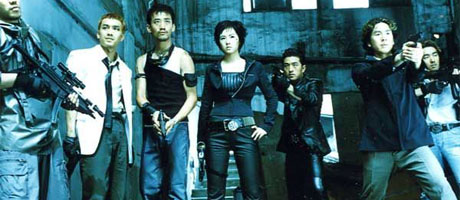
I very much enjoyed this movie once I was able to settle down and actually watch it from beginning to end. It contained the kinetic action sequences coupled with the peculiar brand of understated and yet soap opera-esque acting from the leads I have come to expect from Korean cinema. I do not mean to denigrate the acting skills or performance of either Seung-woo Kim, who played Seok, or Yunjin Kim, who played Hui-su and may be more familiar to readers as Sun Kwon from "Lost," when I describe the style as soap opera-esque. It is a dichotomy that I find interesting that for as reserved as Korean culture can be, and this thought applies to Japanese and Chinese culture and cinema as well, the cinema seems to toy with extremes; when someone is happy they are VERY happy and when someone is sad they are VERY sad, there seems to be little or no middle ground. I could describe it as melodramatic however here melodramatic seems to have a certain amount of negative connotation that I do not want to convey. I think the acting in Yesterday was while not necessarily top notch certainly good.

There were two things I saw in the movie which really jumped out at me. The first was Seon-a Kim, who played the SI officer May (pictured above.) I read somewhere that this role earned her the nickname "Korean Lara Croft" however her subsequent output, which seems to consist of sex comedies, may have put that to rest. Regardless of that she is going on the list. The second thing that caught my eye is the sequence I have captured below as an animated GIF:
 (I know the animated GIF is not working. You can d/l it from here and check it out yourself. I would try to capture the video to something and upload it to YouTube but I have already returned it to the rental place. Sorry!)
This takes places while the SI team is taking heavy fire in an urban environment and I just thought it was a very cool way for a team to move to cover while still providing a moving target and covering fire.
Overall I would recommend this movie to anyone who enjoys Asian cinema and knows what they are in for, however for the uninitiated it might be a bit much to swallow.
Subscribe to:
Posts (Atom)