I recently purchased the uber-dork Buffy the Vampire Slayer box set and have been working through the seasons. Over the weekend I watched the end of season 3, in which Buffy and the gang deal with demons, vampires, Faith (mmmmm….Eliza Dushku) and, oh yeah, the end of high school and all that entails. Watching the cast deal with things applying to and selecting colleges, taking the SATs, prom, and all of the other things which lead up to graduation made me think of Robert Frost’s poem, “The Road Not Taken.”
Two roads diverged in a yellow wood,
And sorry I could not travel both
And be one traveler, long I stood
And looked down one as far as I could
To where it bent in the undergrowth;
Then took the other, just as fair,
And having perhaps the better claim,
Because it was grassy and wanted wear;
Though as for that the passing there
Had worn them really about the same,
And both that morning equally lay
In leaves no step had trodden black.
Oh, I kept the first for another day!
Yet knowing how way lead on to way,
I doubted if I should ever come back.
I shall be telling this with a sigh
Somewhere ages and ages hence:
Two roads diverged in a wood, and I –
I took the one less traveled by,
And that has made all the difference.
From Selected Poems of Robert Frost published by Barnes & Noble, Inc.
It did not take a minute of reflection for me to know why I these episodes brought this particular poem to mind. For me college represents the road not taken even thought I attended the University of Houston for two years after graduation.
If I remember correctly UH was the only school to which I bothered to apply. I will tell people a variety of reasons for this decision but ultimately I think it has more to do with laziness and apathy than anything else. That is not entirely true. There is no way I was going to go to Texas A&M since it seemed like half my high school was going to go there and I wanted something different. As I sit here typing away I am well aware of the irony that attending A&M would have been a much larger change than UH.
Although I was living in the dorms, UH was close enough to home to where I would go home most weekends. Going home on the weekends did two things. First it removed me from much of the social life of the school, and at UH there was not too much of a school=centric social life to begin with. Second it allowed me to continue hanging out with most of my friends from high school. Ultimately going to UH allowed me to prolong my high school years for another two years.
There were some positive experiences at UH. If nothing else I met Rob who has turned out to be one of the best friends a guy can have. But in the end all UH ended up being was an extension of my high school experience rather than the new experience college should be and therefore college remains my road not taken. I took the easier path. And my single largest regret.
Monday, February 12, 2007


Tuesday, February 06, 2007
Moody
I have been in a strange mood, which I typed as “moof” three times in a row before getting it right, the last few weeks. It is difficult for me to describe this mood. I have been a real bear around the office for no real reason and have been very solitary when I have not been at work. I suppose anti-social would be the best descriptor for this mood but there is something else there. I want to say wistful but I am not certain that is the right word. Wistful, for me, carries the connotation of longing for something specific and I can not think of a single thing for which I am pining, except, of course, the fjords, perhaps a bit nostalgic in a melancholy sort of way but not wistful for anything in particular. Then yesterday my iPod, the appropriately named funkywoodjams, spat out this collection of hits from the ‘80s: An odd bit of serendipity.
Tuesday, January 30, 2007
Pardon the Mess
When moving back into these digs I converted the Opiate to the new version of Blogger as well as changed the template. Besides making the format of the blog a bit easier to work with, this broke the Blogger for Word plugin. This sucks for me since I write the VAST majority of my blog posts in Word and clicking on the Post button was so easy. Now I either have to cut and paste from Word into Blogger’s editor, which means I then have to manually remove all of the superfilis HTML tags which Word crams into each document, or I upload the post to Google Documents and post it from there. A process which also requires the manual editing of extra HTML tags. All this is to say that if you see some rather fantastic formatting, it is because I suck at manually editing HTML in the Blogger editor and please bear with me as I wrestle with this thing.
Monday, January 29, 2007
BOOK REVIEW - Just A Geek
 Just A Geek
Wil Wheaton
O’Reilly Media, 2004
267 pgs.
Once in a while a book will come along and just kicks your ass. This ass-kicking can wear many different guises, however it most often manifests itself as the book validates something you were thinking or feeling. For example I know several people who claim to have had a fundamental shift in their world-view as a result of Chuck Palahniuk’s Fight Club but I believe what they went through was more of a revelation than a revolution. In this case Fight Club demonstrated there were other money-grubbing yuppies out there who toed that fine line between artistic self-loathing and emo therefore it was okay for these people to feel the way they had always been feeling. Nothing about their core character changed, the book just gave their feelings validation.
This is the experience I have had over the past several hours as I plowed through Wil Wheaton’s collection of autobiographical sketches Just A Geek. For those of you who do not know him, Wil Wheaton may be better known to you as TV’s Wesley Crusher or Gordie in Stand By Me (he was also in the MASSIVELY underrated Toy Soldiers), and while the True Hollywood Story of teenage Wil is not the subject of this book, I doubt Just A Geek would exist without those experiences. In Just A Geek Wheaton shares experiences from a few years of his life with the reader, years in which he struggles to (re)define and center himself and his life, although it is plain that during the events he relates, Wheaton was unaware of what was happening to him.
For me this book was compulsively readable, so much so that I finished the book in one sitting and it is almost 5AM as I write this review. I am not certain why I bought this book (it was crammed in an Amazon.com order with the uberdork edition of Buffy the Vampire Slayer and a few Shakespeare plays which I am re-reading) I have been aware of wilwheaton.net and wil wheaton dot net in exile for a couple of years now but, for whatever reason, I have never really been engaged by the site. I suspect this has more to do with what I was looking for than what Wil was offering, after all I knew he was an entertaining writer as I enjoyed his short-lived column in one of the Dungeons & Dragons magazines. I know it was not because I have some fannish obsession, either pro or con, with the character of Wesley Crusher. To be completely honest, despite my abiding love for most things Star Trek, I did not watch too much TNG when it first aired (particularly once they got Troi out of her space cheerleader outfits and Yar was no more.) I suppose it was reading Wheaton’s savagely funny commentary on several TNG episodes on TVSquad.com which convinced me to get his book and thus the revelation.
What did reading about the travails of TV’s Wesley Crusher reveal to me? Well, it is difficult to quantify (plus I am starting to get a headache) suffice to say Just A Geek served to validate how I have been feeling about my own life and, more specifically, where I am currently mired creatively. This book really spoke to me and I would encourage you all to read it as it has everything you need. A hero’s journey straight out of Campbell (Joe, not the soup you philstines), porn stars, Monty Python quotes, Trekkies, and roughly the same number of f-bombs I will use at work tomorrow. Enjoy!
Sunday, January 28, 2007
BOOK REVIEW - The Lost Gospel of Judas Iscariot
 The Lost Gospel of Judas Iscariot
Bart D. Ehrman
Oxford University Press, 2006
188 pgs.
Since Bookstop did not have Emperor: The Gods of War I decided to console myself with a couple of other books on The List. In this case they were Lords of the North by Bernard Cornwell, which is the third in his Saxon Stories series and the book we are about to tackle. I have previously read, and reviewed, Ehrman’s Misquoting Jesus: The Story Behind Who Changed the Bible and Why and thoroughly enjoyed it, therefore several of his other books ended up on Christmas list. (This was done with a small sense of irony but more in the hope that my mom, who feels the need to give me something with a Christian every year, might select a book or two from this list. It didn’t work.) This is the one I was most interested in as I had read the National Geographic article about the recovery of the Gospel of Judas and I wondered what this gospel would reveal about Judas.
Rather than restrict himself to a discussion of the text of this new gospel, which I imagine would quickly become boring for the average person, Ehrman makes this book about how the gospel changes our perceptions of Judas, Jesus, and the origins of Christianity itself. Of course, presuming his audience has only a Da Vinci Code inspired knowledge of some of the early non-orthodox Christian beliefs, he has to begin by putting down a foundation of basic knowledge on which he can then build. Through the second, third, and forth chapters he does just this, exploring what we knew about Judas from the early gospel traditions, then the later gospel traditions, and then what we knew about the Gospel of Judas before the document was found. In the next chapter he discusses the circumstance of the discovery of the Gospel of Judas and how it came to be restored, which is an interesting story in and of itself (at least to a history/archaeology geek like myself). Ehrman then starts to deal with the contents of the Gospel of Judas itself. He does this with a very high-level discussion of what is in the Gospel and then digs a little deeper into his discussion of how this Gospel relates to Gnosticism and how it relates to our current knowledge and thoughts about Jesus, Judas, and the other apostles. Finally Erhman wraps up the book with three chapters titled “Who Was Judas Iscariot,” “What Did Judas Betray and Why Did He Betray It?”, and “The Gospel of Judas in Perspective.” Here he flings the gates of the discussion as wide as he can while walking the reader through the steps he takes to boil down what we “know” about these subjects to the most probable facts about the subjects.
Once again Ehrman has provided an illuminating look at Christianity. While reading this book I really felt like I was listening to a lecture by Ehrman rather than delving into some musty academic text and found myself thoroughly enjoying the experience despite the subject being, lets be honest, not very exciting. Like with Misquoting Jesus, I cannot recommend this book enough if you happen to be interested in an intellectual discussion of historical Christianity.
BOOK REVIEW - Emperor: The Field of Swords

Emperor: The Field of Swords
Conn Iggulden
Dell, 2006
594 pgs.
Both of the previous books in the Emperor series, The Gates of Rome and The Death of Kings, have been thoroughly enjoyable reads in which Iggulden tells the story of the rise of Julius Caesar. As with all the books in this series Iggulden has to cover quite a bit of historical ground the end of Caesar’s posting in Spain, his election to consul, his conquest of Gaul, and ends with the line, "As the sun rose, the veteran legions of Gaul crossed the Rubicon and marched on Rome."
I honestly do not know what to say about this book. While Iggulden’s prose is enjoyable, it is his characters which really make the book worth reading. He has a knack for telling the reader everything they need to know about a character in one scene without making the character feel like a sketch or a cliché. It is because of this, more than any other factor, that Iggulden has become one of my favorite authors, so much so that I have dispatched one of my minions friends to Britain to fetch me Wolf of the Plains, the first book of his new series about Genghis Khan. (Of course he, my minion friend, will tell you he went back because it was his mom’s birthday, and we should allow him to cling to this thin fiction, but we all know the truth. Okay, back to semi-serious stuff.) The only room for improvement that I see is in how Iggulden constructs his narrative. Between some chapters there will be significant jumps in time and there is nothing to indicate these shifts except for a throw away line early in the chapter, which can, at times, be disorienting. In the end this is only a minor quibble which does not detract from my enjoyment of the book.
The best way I know how to recommend this book is to tell you that I read the almost 600 pages in about a week and once I was done I immediately went to the bookstore to pick up the final volume in the series, The Gods of War. (Sadly they did not have it yet somehow I still managed to spend over $40 at the bookstore.)
When I read the following quote I thought it would make the perfect tageline for a movie trailer:
“From this day, all tribal disputes are ended. Let no Gaul kill one of his people when we shall need every sword against the enemy. When there is dissent, use my name,” Cigento said softly, “Tell them Vercingetorix calls them to arms.”
Too bad Vercingetorix looses in the end.
BOOK REVIEW - A Year in the Life of William Shakespeare
 A Year in the Life of William Shakespeare: 1599
James Shapiro
Harper Perennial, 2005
394 pgs.
In this book Shapiro proposes to show us that while Shakespeare’s plays have endured for centuries, Shakespeare was addressing issues which would have been as present in the Victorian mind as terrorism and
Shapiro structures the book around the four seasons, winter, spring, summer, and autumn, tying each play to the season in which it was written or first performed. This puts Henry the Fifth in the Winter, during which Shakespeare had a conflict with the other, perhaps more prominent Will, in the Chamberlain’s Men, Will Kemp, the troupe’s clown. Before this point it had been the practice for the clown to perform a jig or two at the end of the play. These jigs were often bawdy and Will Kemp is reputed to be one of the past masters of the jig, but more importantly the jig gave the clown the last word rather than the playwright, something which, I imagine, stuck in more than one writer’s craw. In the larger world the English were facing a crisis in
These are just a couple of the examples, as poorly related as they may be by yours truly, which Shapiro uses to show the reader how topical Shakespeare’s work was for the audiences of his day. If you have any interest in Shakespeare then this is a book you should definitely find time to read.
Wednesday, January 24, 2007
Pro-Choice
Abortion is not a subject that I spend much time thinking about. I know where I stand on the subject on both a public policy front (it should be legal with as few impediments as possible) and a personal front (I think it is morally wrong unless there is significant danger to the mother) and, lets face it, I am certainly not having enough (any) sex for it to be a concern. The one opinion I have about abortion which I tend to share is the frustration I feel about the public debate about abortion. We all know the two sides of the debate are never going to agree and yet everyone throws so much time, money, and effort into this abyss. I wonder what we could accomplish if we took all those resources and focused them on something we can fix, like children living in poverty, or the number of people living without adequate health care, anything but abortion.
Like I said, it is not something I think about much because I know where I stand and I really feel it is an issue best left between God, the mother, and the father. Then today I saw this post on Ragnell’s Written World (which, by the way, is a superlative comics blog wherein Ragnell takes on a lot of women’s issues in comics and the age old question of which Green Lantern has the nicest butt (Soranik Natu)) which put into words how I feel about many things the religious right would like to have legislated, but particularly abortion. Ragnell’s point is that by being pro-choice she is, in effect, in favor of a person being responsible for their own decisions. If abortion is outlawed then it is easy for a woman to shrug her shoulders and say, “Well, I have to have the baby.” She has no choice and therefore has the opportunity to foist off responsibility for the consequences of getting pregnant on society. Of course she still has to deal with the consequences, but by removing her choice to have an abortion, you move her from being an adult making adult decisions to a victim of circumstance. Go read the write up from Ragnell. She explains it far better than I and while you’re there check out the rest of her blog. While I regularly just about wet myself with the offerings from Campbell, Church, and Sims, Ragnell’s writing often forces me to think about issues in a much larger context and she is worthy of your attention.
Sunday, January 21, 2007
BOOK REVIEW - The J Curve
 The J Curve: A New Way to Understand Why Nations Rise and Fall
Ian Bremmer
306 pages
Simon & Schuster, 2006
The description on the front flap of the dust cover says, “What Freakonomics does for understanding the economy, The J Curve does for better understanding how nations behave,” and, quite frankly, this is one of the most accurate sentence-long summations of a book I have ever read. Just like Freakonomics, The J Curve is a fascinating and illuminating read.
The central question that Bremmer intends this book to answer is, “How can we better understand the natural processes that erode the power of authoritarian regimes and nourish open governance?” As he indicates in the very first paragraph of the Foreward this process is important for us to understand in this age where political instability in one nation, or even within a small region of a state, can lead to a myriad of nightmare scenarios including regional economic instability and nuclear terrorism. He goes on to point out that this understanding is critical to formulating more effective foreign policy.
The center piece of Bremmer’s method of answering this question is the titular J curve. Basically Bremmer’s J curve plots the stability of a nation on the Y axis and the openness of the nation on the X axis. This curve, which resembles a check mark more than an actual J, has states with authoritarian regimes, such as
After introducing the J curve model, Bremmer then walks the reader through several different examples of states at various points on the curve, beginning with three states which are on the extreme left of the curve,
Bremmer then discusses
Bremmer then takes the reader step-by-step through states which demonstrate the two other major positions on the J curve. The depths of the J curve are exemplified by
This book was a very enjoyable and surprisingly quick read considering the subject matter and I highly recommend it to any person with an interest in the rise and fall of states in the post Cold War world.
Saturday, January 20, 2007
New Years Resolutions
- Go to the gym twice a week and improve this mark to three times a week by August.
- Cook something new at least once a month but try to do it twice a month.
- Read a book every two weeks and write a review for every book I read.
- Deposit at least $100.00 out of every paycheck into my credit union savings account.
- Complete the first round of JAS Houston language courses.
- Work though The Artist’s Way.
- Finish at least two writing projects this year that are NOT poetry.
- Write three posts a week for the Opiate.
Tuesday, January 16, 2007
So Is This Thing Still On?
It appears that my one-month hiatus to write the marginally okay American novella turned into two months and some change. First I have to admit that I have, to a certain extant, enjoyed the break. While I love writing, I was starting to feel like writing for the Opiate was a chore. To be completely honest writing in general had become a chore.
Towards the end of October I was really pumped about NaNoWriMo. I expected the end product to be, lets face it, crap, however I did expect there to be an end product. Guess what? There wasn’t. Well, that is not entirely true, at the end of the month (I punked out about halfway through) I had about ten pages of material. Mind you this material is four or five two-page starts on several different ideas rather than one project. Apparently I was rather scatter-brained while I was trying to work on my novel and I could not discipline myself enough to work on just one idea. I am a little disappointed in myself, but we all have these creative ups and downs.
Once November was over I made several attempts to begin writing for the Opiate however the words just would not come. I justified this by telling myself I was busy with holiday stuff (and I was) or I excused it by blaming it on some girl problems I experienced (more on that particularly bad weekend later). The fact of the matter is that I was burned out. I did quite a bit of thinking about various creative projects which have been floating around in my head for varying amounts of time and I wasted a HUGE amount of time in front of the television.
In the end I wasted about two months. I should have been writing anything rather than doing the creative equivalent of sitting on my duff but c’est la vie. There will be no more crying over this particular milk spill. It is time to look forward. I am well-rested after a week and some change in
Happy New Year and welcome back. Thanks for reading.
Tuesday, October 31, 2006
Taking a Break
What the heck is going on here? There I was, chugging along with a fairly nice head of steam, posting every day and ending each day with the next day’s post in mind and then last week things just seemed to fall apart on me. As much as I want to blame the caffeine and beer, I have to be honest with you, it was the learnin’ that got me.
I spent the last week in training for a software package we recently purchased at the office and this training was very intellectually challenging. It has been a long time since I got home from anything and I was physically tired because of the amount of thinking I had been doing that day. It was exhausting in a very pleasant way. I am sure part of my exhaustion comes from the fact that much of the training, which was in digital forensics, took place about three levels above what I actually understand about computers and therefore I was having to spend time either Googling for information to fill in the blanks or, far more often, trying to make leaps of logic on my own. I find this happening fairly often in my new job. People assume that I know far more about computers and how they work than I actually know, therefore I am forever having to make things up as I go along or channeling my kung fu inscrutability and telling people I think I can do something but I have to check on something else first. It is both fun and terrifying as I enjoy the challenges this presents but I am also worried that someone is going to figure out that I don’t know as much as I pretend to know. I guess I will just have to plant those special poppies around the castle to keep people out.
As I said the training was, while intellectually exhausting, a lot of fun and it provided me with another one of those, “Gee, this really is a small world, isn’t it?” moments. One of the trainers was a guy from my high school graduating class. We went to school together from 5th grade through high school and knew one another because we were both in band. Beyond that we did not really run in the same social circles. When he walked in on the second day of training and I heard his name I had that moment where I was wondering if he was the same guy I had gone to school with. I didn’t ask because I am really uptight about stupid things and I wanted to save myself the embarrassment of being wrong. (I HATE being wrong.) His voice was familiar, however I am a stubborn fool and so the question wasn’t resolved until the lunch break when he asked where I had gone to school. We chatted about old friends and had the “Where Are They Now?” catch-up session in which I discovered I have inadvertently kept track of far more people I knew in high school than I thought. (And this doesn’t even count the ones I have stalked on the internet.) It was cool to reconnect with someone I had not seen in over fourteen years.
Now that I have given you my excuse for the last couple of weeks I need to move in to making my excuses for the next four weeks. Tomorrow is November 1st and this marks the beginning of National Novel Writing Month and after missing the boat last year I have thrown my hat in the ring. For those of you unfamiliar with National Novel Writing Month, or NaNoWriMo as it is affectionately called by the left coast collective that came up with this little brain-burner, the entire point is to write a 50,000 word piece of prose between November 1st and November 30th. A quick bit of math will tell you that this works out to 1666.67 words per day. To give you an idea of how many words that is, this is the 684th word of this post and I just pushed past the first page of this post in MS Word. Three pages of prose a night is definitely an achievable end, particularly since the key to completion is not to edit at all and that (besides poorly constructed run-on sentences) is my single largest problem as a writer. I end up working on a project and getting about ten pages in before the need to revise takes over and I end up with about five pages of polished text before I am burned out or have lost the thread of my story. This time the quality of writing doesn’t matter, just the quantity; the goal is to reach the 50,000-word mark by midnight, November 30th. It is definitely doable.
All of this is by way of saying that I am going to take a break from writing for the Opiate. Over the next thirty days I need to concentrate my writing time on crossing this particular finish line. On top of that we have this little thing called Thanksgiving crammed in there at the end of the month which means I am going to have to be spending some quality time with the family (not that I mind) right in the midst of that critical, “Oh God I have slacked off all month and need a couple of caffine and Monster fueled nights of mad writing to get this done,” time period.
Before I sign off for the month I had a couple of house keeping things to do:
Wish me luck cause here goes nothing.
(1,254 words.)
I spent the last week in training for a software package we recently purchased at the office and this training was very intellectually challenging. It has been a long time since I got home from anything and I was physically tired because of the amount of thinking I had been doing that day. It was exhausting in a very pleasant way. I am sure part of my exhaustion comes from the fact that much of the training, which was in digital forensics, took place about three levels above what I actually understand about computers and therefore I was having to spend time either Googling for information to fill in the blanks or, far more often, trying to make leaps of logic on my own. I find this happening fairly often in my new job. People assume that I know far more about computers and how they work than I actually know, therefore I am forever having to make things up as I go along or channeling my kung fu inscrutability and telling people I think I can do something but I have to check on something else first. It is both fun and terrifying as I enjoy the challenges this presents but I am also worried that someone is going to figure out that I don’t know as much as I pretend to know. I guess I will just have to plant those special poppies around the castle to keep people out.
As I said the training was, while intellectually exhausting, a lot of fun and it provided me with another one of those, “Gee, this really is a small world, isn’t it?” moments. One of the trainers was a guy from my high school graduating class. We went to school together from 5th grade through high school and knew one another because we were both in band. Beyond that we did not really run in the same social circles. When he walked in on the second day of training and I heard his name I had that moment where I was wondering if he was the same guy I had gone to school with. I didn’t ask because I am really uptight about stupid things and I wanted to save myself the embarrassment of being wrong. (I HATE being wrong.) His voice was familiar, however I am a stubborn fool and so the question wasn’t resolved until the lunch break when he asked where I had gone to school. We chatted about old friends and had the “Where Are They Now?” catch-up session in which I discovered I have inadvertently kept track of far more people I knew in high school than I thought. (And this doesn’t even count the ones I have stalked on the internet.) It was cool to reconnect with someone I had not seen in over fourteen years.
Now that I have given you my excuse for the last couple of weeks I need to move in to making my excuses for the next four weeks. Tomorrow is November 1st and this marks the beginning of National Novel Writing Month and after missing the boat last year I have thrown my hat in the ring. For those of you unfamiliar with National Novel Writing Month, or NaNoWriMo as it is affectionately called by the left coast collective that came up with this little brain-burner, the entire point is to write a 50,000 word piece of prose between November 1st and November 30th. A quick bit of math will tell you that this works out to 1666.67 words per day. To give you an idea of how many words that is, this is the 684th word of this post and I just pushed past the first page of this post in MS Word. Three pages of prose a night is definitely an achievable end, particularly since the key to completion is not to edit at all and that (besides poorly constructed run-on sentences) is my single largest problem as a writer. I end up working on a project and getting about ten pages in before the need to revise takes over and I end up with about five pages of polished text before I am burned out or have lost the thread of my story. This time the quality of writing doesn’t matter, just the quantity; the goal is to reach the 50,000-word mark by midnight, November 30th. It is definitely doable.
All of this is by way of saying that I am going to take a break from writing for the Opiate. Over the next thirty days I need to concentrate my writing time on crossing this particular finish line. On top of that we have this little thing called Thanksgiving crammed in there at the end of the month which means I am going to have to be spending some quality time with the family (not that I mind) right in the midst of that critical, “Oh God I have slacked off all month and need a couple of caffine and Monster fueled nights of mad writing to get this done,” time period.
Before I sign off for the month I had a couple of house keeping things to do:
- My brother sent me a link to The Marmot’s Hole, a blog about Korea from the vantage point of an ex-pat.
- Somewhere I stumbled across OhMyNews.com which appears to be an experiment in citizen journalism based in Korea. There I stumbled across this article where I learned that part of Gyeongbokgung had just been opened the weekend I was there at the palace on my most recent trip.
- I have FINALLY posted the pictures from my trip to Tokyo and Korea in my Webshots account. I broke them down in to Tokyo Cityscapes, Tomioka Hachiman Shrine, Senso-ji Temple, Meiji-jingu Shrine, Hanshin Tigers Game, Sengaku-ji Temple, Imperial Palace, Seoul Cityscapes, War Memorial, Deoksugung, Korea House, and Gyeongbokgung. You may note that there are no pictures of my friend, Nobuyuki, or his family. He asked that I not post pictures of them to the internet. This spring and summer the ultra-national fundamentalists in Japan have discovered a taste for the terrorist actions and since Nobuyuki is active in national politics in Japan (and about a diametrically opposed to everything the jingoist fundamental choad weasels stand for) he thinks it would be safer if no pictures of his family appear on the web. I think it is sad that we have to take precautions like this however I will certainly do nothing to put them at risk and would have not posted them without any explanation at all. (It is too bad, too, because there is a really funny picture of me cutting up with his kid.) Sorry it took me so long to get this done.
- If anyone wants to keep track of how I am doing or be a writing buddy, my NaNoWriMo user ID is, surprise surprise, funkywoodjam.
- Happy Halloween!
Wish me luck cause here goes nothing.
(1,254 words.)
Tags: FWJ, Opiate, Photography, Words
Saturday, October 21, 2006
FWJ - Fashion Plate
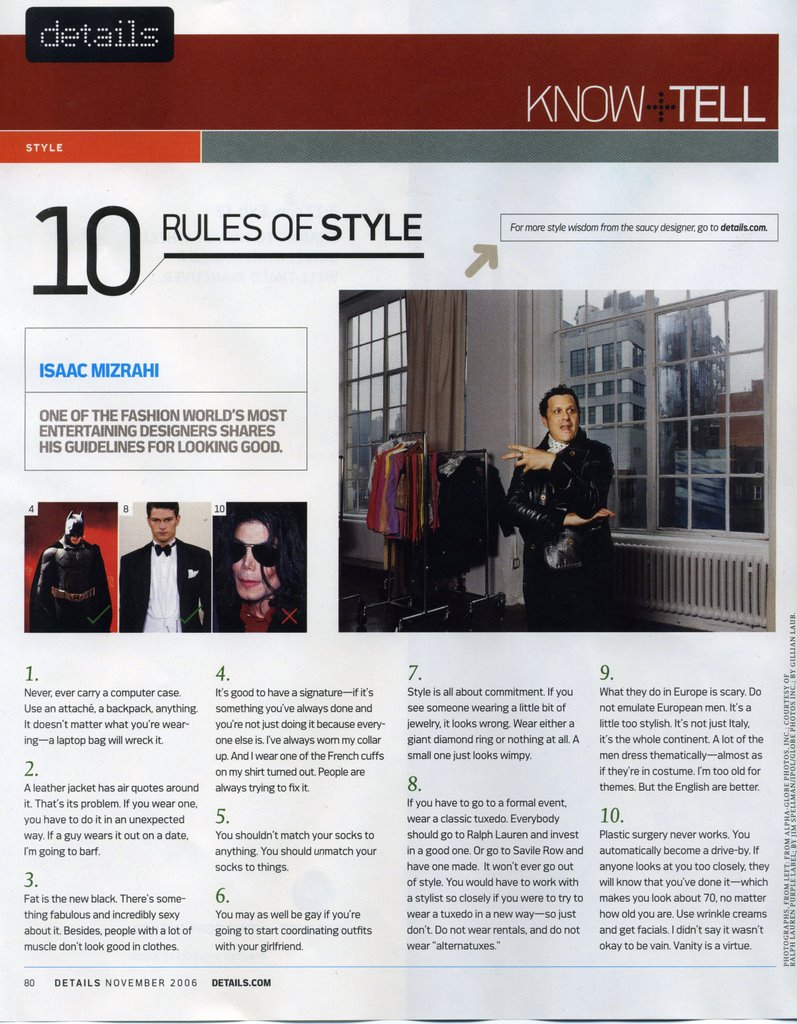
I have always suspected that Christina Aguilera's latest song, "Ain't No Other Man," referred to me, but I was a bit skeptical about the line discussing style. Then I read this column in the November issue of Details (yes, I read Details. Shut it.)

Take a closer look at #3, thoughtfully magnified for you by yours truly:
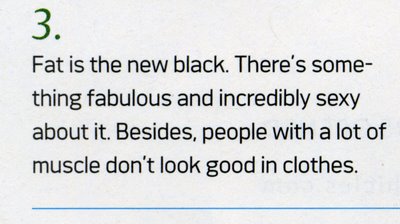
That's right, according to Isaac Mizrahi I might actually be hipper than I knew. I thought it important you all know this so you can treat me with the appropriate amount of deference.
Take a closer look at #3, thoughtfully magnified for you by yours truly:
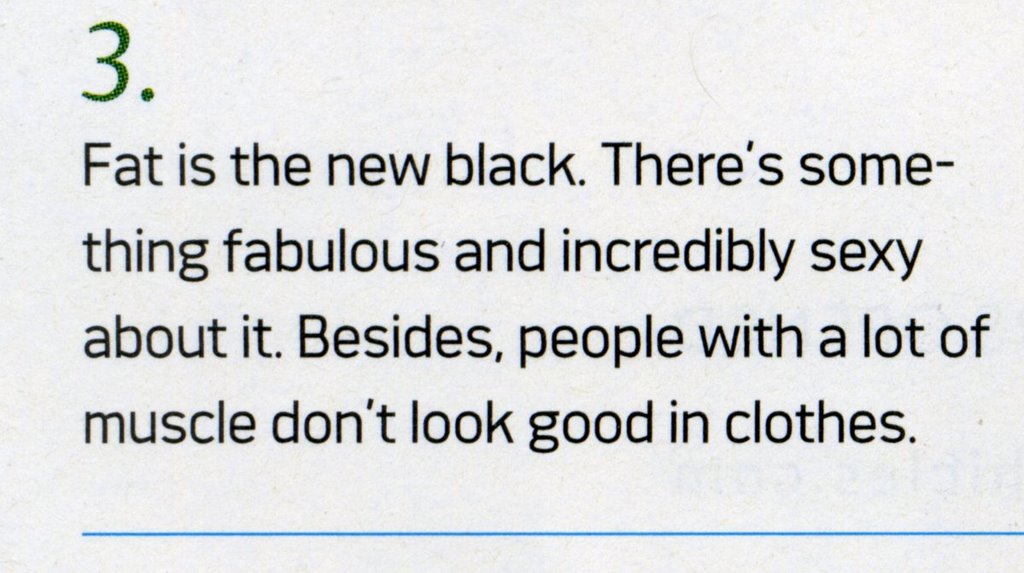
That's right, according to Isaac Mizrahi I might actually be hipper than I knew. I thought it important you all know this so you can treat me with the appropriate amount of deference.
Friday, October 20, 2006
Four Color Commentary - Books Shipped 10-18-2006
I am almost all caught up with comics so you know what this means? Still no commentary for you! My brother is coming to visit this weekend and I still have too much to do to get the casa ready so I haven’t been able to read enough. Maybe next week.
- 52 #24
- Geoff Johns, Grant Morrison, Greg Rucka, and Mark Waid, Writers
- Keith Giffen, Art Breakdowns
- Phil Jimenez, Penciller
- Andy Lanning, Inker
- The Authority #1
- Grant Morrison, Writer
- Gene Ha, Artist
- Batman and the Mad Monk #3
- Matt Wagner, Writer & Artist
- Birds of Prey #99
- Gail Simone, Writer
- James Raiz, Penciller
- Robin Riggs, Inker
- Catwoman #60
- They’re still doing f-ed up credits so you’ll get none and like it.
- Checkmate #7
- Greg Rucka, Nunzio DeFilippis & Christina Weir, Writers
- Cliff Richards, Penciller
- Bob Wiacek & Dan Green, Inkers
- Conan #33
- Timothy Truman, Writer
- Cary Nord, Artist
- The Flash, The Fastest Man Alive #5
- Danny Bilson & Paul Demeo, Writers
- Ron Adrian, Penciller
- Alex Lei & Rob Lea, Inkers
- Highlander #1
- Brandow Jerwa and Michael Avon Oeming, Writers
- Lee Moder, Artist
- Queen & Country #31
- Greg Rucka, Writer
- Chris Amnee, Artist
- Red Sonja #15
- Michael Avon Oeming, Writer
- Mel Rubi & Stephen Sadowski, Artists
- Rex Mundi #2
- Arvid Nelson, Writer
- Juan Ferreyra, Artist
- Robin #155
- Adam Beechen, Writer
- Freddie E. Williams II, Artist
- Shadowpact #6
- Bill Willingham, Writer
- Cory Walker, Artist
- Ultimate Fantastic Four #35
- Mike Carey, Writer
- Pasqual Ferry, Artist
- Union Jack #2 (of 4)
- Christos N. Gage, Writer
- Mike Perkins, Penciller
- Andrew Hennessy, Inker
- Wildcats #1
- Grant Morrison, Writer
- Jim Lee, Penciller
- Scott Williams, Inker
- Wolverine #47
- Marc Guggenheim, Writer
- Humberto Ramos, Penciller
- Carlos Cuevas, Inker
- X-Men: First Class #2 (of 8)
- Jeff Parker, Writer
- Roger Cruz, Penciller
- Victor Olazaba, Inker
Tags: Comics
Thursday, October 19, 2006
The Opiate Goes World Wide
Today was a red banner day for visitors from other countries here on the Opiate. In addition to the usual mob from Texas that reads I had visitors from Japan (Hi Corey!), Mexico, Hungary, China, Norway, Spain, and Canada. On top of that I learned that the Opiate placed second in the Google search for "birthday parties opiate of the masses" (you can view the results here) and third in a Google search for "is Kim Jong a crossdresser" (results here). My question to the person from Pennsylvania wondering about the Dear Reader's dressing habits is, "Do we really care? He has nukes and we're represented at the UN by this guy."

Something about glasses houses and throwing stones. Anyways, I just wanted to share.
Something about glasses houses and throwing stones. Anyways, I just wanted to share.
Tags: Opiate
The Military Commissions Act of 2006
When I read about Bush signing the Military Commissions Act of 2006 into law I tried to dig up some outrage. I looked down in me and found I really had nothing but an acute sadness. George Walker Bush managed to join a select group of Presidents which includes such luminaries as Franklin Delano Roosevelt (and here) and John Adams (and here), a feat of which I, quite frankly, thought he was incapable. While inaugurating himself into this august company President Bush also took the largest step in conceding the “War on Terror” to the terrorists. The best piece I have seen so far is this from Keith Olbermann:
He pretty much said everything I was thinking and I was a little down about it. Then I read this:
He pretty much said everything I was thinking and I was a little down about it. Then I read this:
When, in the Course of human Events, it becomes necessary for one People to dissolve the Political bands which have connected them with another, and to assume, among the Powers of the Earth, the separate and equal Station to which the Laws of Nature and of Nature’s God entitle them, a decent Respect to the Opinions of Mankind requires that they should declare the Causes which impel them to the Separation.In the 230 years since those words were written they have become one of the sacraments of liberty and they make me tear up a little every time I read them.
We hold these Truths to be self-evident: that all Men are created equal, that they are endowed, by their Creator, with certain unalienable Rights, that among these are Life, Liberty, and the Pursuit of Happiness.
That to secure these Rights, Governments are instituted among Men, deriving their just Powers from the Consent of the Governed, that whenever any Form of Government becomes destructive of these Ends, it is the Right of the People to alter or abolish it, and to institute new Government, laying its Foundation on such Principles, and organizing its Powers in such Form, as to them shall seem most likely to effect their Safety and Happiness.
Prudence indeed, will dictate, that Governments long established, should not be changed for light and transient Causes; and accordingly all Experience hath shewn, that Mankind are more disposed to suffer, while Evils are sufferable, than to right themselves by abolishing the Forms to which they are accustomed. But when a long Train of Abuses and Usurpations, pursuing invariably the same Object, evinces a Design to reduce them under absolute Despotism, it is their Right, it is their Duty, to throw off such Government, and to provide new Guards for their future security.
Wednesday, October 18, 2006
What're the Odds?
My whiney bitchfest continued today at work. I managed to whinge to Nikki via IMs for about 30 minutes. Most of the ground I covered in last night’s depressed-fest so I will spare you the gory details however I did some thinking about dating, or more specifically how I behave while dating, that I felt worthy of sharing before we actually get to the point of today’s post. When I start dating someone I want to spend all the time I can with them however I happen to have a lot of free time and therefore have to fight the urge to call/email/text the person to see if they want to hang out all the time. I don’t want to come off as overly needy and/or pushy. So I successfully fight the urge to do this and then I start to worry that I might be coming off as stand-offish or disinterested. Can anyone answer this particular conundrum?
Okay, on with the post. So part of my complaining to Nikki was that my life is really stuck in a bit of a rut right now. I went on and on about it and eventually got cheered up by taking cheap shots at people and cities who think banning smoking in bars is the Right Thing to Do™. (More on this tomorrow.) Once I felt better about myself it was time to surf the web where, from parts unknown, I stumbled across xkcd.com which tickled my funny-bone so I settled in to read it all. 137 strips in I stumbled across this gem, the major text of which is:
Once again my wanderings on the Internet have offered up some bit of advice addressing my crisis du jour. I felt the need to share.
Bonus
I totally do this:
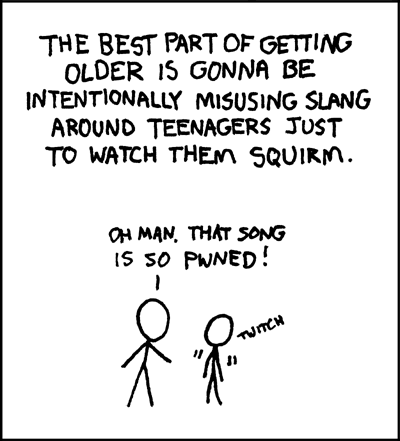
Okay, on with the post. So part of my complaining to Nikki was that my life is really stuck in a bit of a rut right now. I went on and on about it and eventually got cheered up by taking cheap shots at people and cities who think banning smoking in bars is the Right Thing to Do™. (More on this tomorrow.) Once I felt better about myself it was time to surf the web where, from parts unknown, I stumbled across xkcd.com which tickled my funny-bone so I settled in to read it all. 137 strips in I stumbled across this gem, the major text of which is:
The infinite possibilities each day holds should stagger the mind. The sheer number of experiences I could have is uncountable, breathtaking, and I’m sitting here refreshing my inbox. We live trapped in loops, reliving a few days over and over, and we envision only a handful of paths laid out ahead of us. We see the same things each day, we respond the same way, we think the same thoughts, each day a slight variation on the last, every moment smoothly following the gentle curves of societal norms. We act like if we just get through today, tomorrow our dreams will come back to us.
And no, I don’t have all the answers. I don’t know how to jolt myself into seeing what each moment could become. But I do know one thing: the solution doesn’t involve watering down my every little idea and creative impulse for the sake of some day easing my fit into a mold. It doesn’t involve tempering my life to better fit someone’s expectations. It doesn’t involve constantly holding back for fear of shaking things up.
Once again my wanderings on the Internet have offered up some bit of advice addressing my crisis du jour. I felt the need to share.
Bonus
I totally do this:
Tuesday, October 17, 2006
"Its not like me I'm DEPRESSED!"
Okay, so it is like me. I managed to fend off my annual birthday funk until almost two weeks after the fact. I would like to thank the Korean Krud I managed to come down with after my visit there and all the people who showed up at my place Saturday night for one of the rockinest parties I have ever had the honor of co-hosting for the help. But now all that is behind me and for some reason today was just the day that it decided to rear its ugly head. Tonight I took myself out to dinner at Auntie Chang's and then over to Downing for a couple of Monte Cristos and Kronenbourg 1164s. While at Downing I wrote several pages in my journal which I kind of intended to just scan and post here in lieu of actually writing anything for the Opiate ('cause Lord knows I don't have enough stuff on my plate to write about already, travelouges, three or four book reviews, my thoughts on the couple of new shows I am watching this season, and the DPRK's preparing for another nuclear test). Then I was thinking about what I wrote and I can really sum it up for you in one fairly simple sentence. I am a whiney little bitch who feels alone in the world and wanted to cry about it tonight. Oh well, I will spare you the whining and promise more entertaining content tomorrow night. Until then have a good one!
Tags: FWJ
Monday, October 16, 2006
What Pyongyang Really Wants
Guess what? I was thinking about the Korean situation a little more the other night and it has occurred to me what the leaders in Pyongyang really want and I thought I would share my revelation with you. I believe their demands could really be boiled down to that they want to sit down with the United States one-on-one to talk. Why is this so important to them? Particularly in today’s world where there are plenty of other nations out there willing to work with them just to spite the United States.
In order to answer this question we have to dig back a couple of years. It is important to remember that this is something we have been dealing with since 1989 when satellite photos indicate new construction at Yongbyon which leads U.S. intelligence analysts to believe that North Korea is in the early stages of building a nuclear weapon. North Korea signed on to the NPT (Non-Proliferation Treaty) in 1985 but had yet to allow international teams to inspect its nuclear facilities. Inspectors are not on the ground in North Korea until some time in 1992 however they are quickly rebuffed and within a year Hans Blix admits that the inspectors cannot assure the rest of the world that North Korea has suspended its nuclear programs.
North Korea has had a nuclear power program since 1965 when the Soviet Union assembled a IRT-2M research reactor in Yongbyon. By 1980 the North Koreans had begun construction on a 5MWe reactor and by August of 1985 this reactor was on-line. Why did they wait until 1989 to start a nuclear arms program?
Of course the argument could be made that they had not waited at all and have been working on atomic weapons all along. I believe if this were the case, or rather if they had been making a serious effort before 1989, we would have heard about it by now therefore I feel safe making the assumption that any nuclear program in the country before 1989 was not a serious, concerted effort. This brings us back to the question of why wait until 1989? They had the material and, presumably, the knowledge in place since 1985 to begin a program.
I believe the answer lies in events that were taking place on the other side of the world. With Mikhail Gorbachev’s ascension to the post of General Secretary of the Central Party of the Soviet Union the world began to see a radical shift in the balance of power which found its ultimate expression in November of 1989 when the Berlin Wall was torn down. What this indicated was that the Soviet’s, the primary patrons of communist states around the world including North Korea, were turning their eyes inward to deal with their internal problems. This effort would ultimately “fail” resulting in the dissolution of the Soviet Union a mere two years later. This retreat from the world left several states in a state of limbo, notably North Korea.
Why was the Soviet Union so important to North Korea, particularly considering the close ties they have had with China? According to Don Oberdorfer’s book The Two Koreas the regime in Pyongyang became very adept at playing China and the Soviet Union off of each other after the Sino-Soviet split. This gave North Korea a degree of power in the region that was completely divorced from any economic or other considerations. They were able to provide the Soviets with information or not provide the Soviets with information and this made them powerful. Therefore in the years from 1989 to 1991, not only did they lose the financial support provided by the Soviet Union, but they were reduced to a Chinese client state, a geopolitical reality which terrified the regime in Pyongyang.
Ultimately North Korea wants to be our “friend” so they can continue the game they have played since the late ‘50s however instead of pitting Moscow against Beijing, they want to pit Washington against Beijing. Still unsure? Read this quote from an unnamed North Korean official:
In order to answer this question we have to dig back a couple of years. It is important to remember that this is something we have been dealing with since 1989 when satellite photos indicate new construction at Yongbyon which leads U.S. intelligence analysts to believe that North Korea is in the early stages of building a nuclear weapon. North Korea signed on to the NPT (Non-Proliferation Treaty) in 1985 but had yet to allow international teams to inspect its nuclear facilities. Inspectors are not on the ground in North Korea until some time in 1992 however they are quickly rebuffed and within a year Hans Blix admits that the inspectors cannot assure the rest of the world that North Korea has suspended its nuclear programs.
North Korea has had a nuclear power program since 1965 when the Soviet Union assembled a IRT-2M research reactor in Yongbyon. By 1980 the North Koreans had begun construction on a 5MWe reactor and by August of 1985 this reactor was on-line. Why did they wait until 1989 to start a nuclear arms program?
Of course the argument could be made that they had not waited at all and have been working on atomic weapons all along. I believe if this were the case, or rather if they had been making a serious effort before 1989, we would have heard about it by now therefore I feel safe making the assumption that any nuclear program in the country before 1989 was not a serious, concerted effort. This brings us back to the question of why wait until 1989? They had the material and, presumably, the knowledge in place since 1985 to begin a program.
I believe the answer lies in events that were taking place on the other side of the world. With Mikhail Gorbachev’s ascension to the post of General Secretary of the Central Party of the Soviet Union the world began to see a radical shift in the balance of power which found its ultimate expression in November of 1989 when the Berlin Wall was torn down. What this indicated was that the Soviet’s, the primary patrons of communist states around the world including North Korea, were turning their eyes inward to deal with their internal problems. This effort would ultimately “fail” resulting in the dissolution of the Soviet Union a mere two years later. This retreat from the world left several states in a state of limbo, notably North Korea.
Why was the Soviet Union so important to North Korea, particularly considering the close ties they have had with China? According to Don Oberdorfer’s book The Two Koreas the regime in Pyongyang became very adept at playing China and the Soviet Union off of each other after the Sino-Soviet split. This gave North Korea a degree of power in the region that was completely divorced from any economic or other considerations. They were able to provide the Soviets with information or not provide the Soviets with information and this made them powerful. Therefore in the years from 1989 to 1991, not only did they lose the financial support provided by the Soviet Union, but they were reduced to a Chinese client state, a geopolitical reality which terrified the regime in Pyongyang.
Ultimately North Korea wants to be our “friend” so they can continue the game they have played since the late ‘50s however instead of pitting Moscow against Beijing, they want to pit Washington against Beijing. Still unsure? Read this quote from an unnamed North Korean official:
It would be good for the United States to have us as a neutral buffer state in this dangerous area. Who knows, perhaps there are ways in which the United States could benefit from our ports and out intelligence if we become friends.
Sunday, October 15, 2006
Sunday
Last night we had a party and I am VERY hungover today therefore in lieu of any actual content I would like to offer this video of my reaction to a truly foul drink Scott inflicted on me on my birthday. Have a good one, I am headed back to bed.
Okay, while I was logging on to YouTube to get the links to my video I found this:
I haven't even got the words.
Okay, while I was logging on to YouTube to get the links to my video I found this:
I haven't even got the words.
Subscribe to:
Posts (Atom)